Home / News & Events / Product News / Reducing Hydraulic Motor Total Cost of Ownership: How Blince LD Series Helps Operators Control TCO from Selection to Maintenance
Reducing Hydraulic Motor Total Cost of Ownership: How Blince LD Series Helps Operators Control TCO from Selection to Maintenance
Views: 0 Author: Site Editor Publish Time: 2026-04-08 Origin: Site
In the construction machinery and industrial equipment sectors, the sticker price of a hydraulic motor is really just the tip of the iceberg. When you look at the total cost of ownership (TCO) over a machine's full operational life, the initial purchase price is actually a surprisingly small fraction of your overall spend.
Industry data paints a clear picture: annual maintenance for heavy equipment hydraulic systems averages 10% to 15% of the original purchase price. If you’re running a construction machine with a ten-year lifespan, your accumulated spending on maintenance, repairs, and component replacements can easily reach two to four times what you paid for the hydraulic parts on day one. The takeaway here is simple—buying a motor simply because it has the lowest upfront price is often the fastest way to blow your long-term budget.
True TCO encompasses a lot more than the invoice. You have to factor in installation and commissioning (like piping and valve adaptations), daily energy costs driven by motor efficiency, routine maintenance labor, and the brutal costs of unplanned downtime and end-of-life replacements.
Managing these costs requires smart decisions at every stage of the equipment's life. This is exactly why the Blince hydraulic motor series is engineered to address these multi-dimensional lifecycle needs.
Phase 1: Getting the Specs Right from Day One
The most stubborn, difficult-to-reverse costs stem from poor initial selection. A slight mismatch in specifications can cause hidden efficiency losses during every single shift.
For instance, if you choose a motor with a rated pressure that's too low, it ends up running constantly near its absolute limit, causing seals to age up to three times faster. Similarly, undersizing the displacement forces the system to push higher flow rates to hit target speeds, which overloads the hydraulic pump and burns out the oil prematurely.
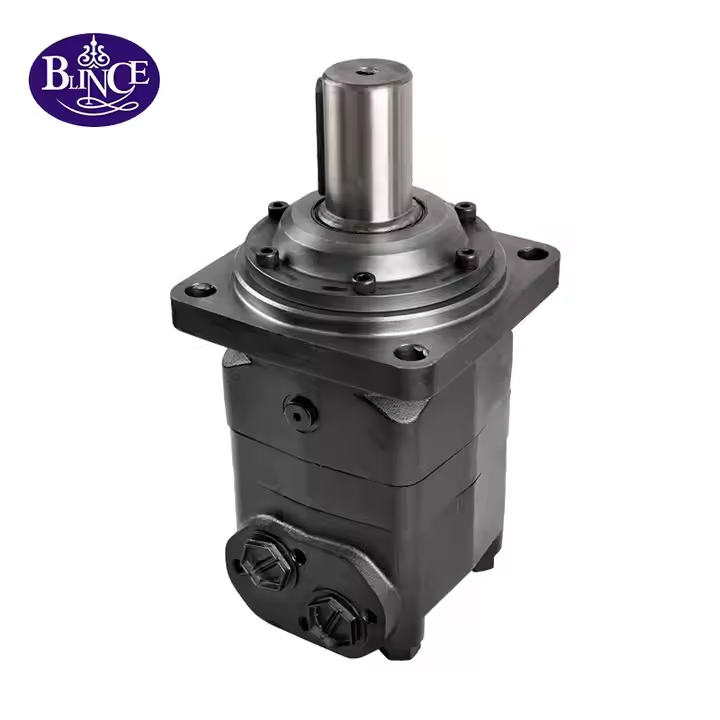
To solve this, our product line spans a massive power spectrum. From compact units to reliable LD series radial piston motors, we cover rated pressures up to 35 MPa and displacements pushing 100 cc/r. Take the LD 2 model: with operating noise kept under 70 dB and a minimum stable speed of just 20 rpm, it's perfect for precision automation like robot joints and medical equipment. Upgrading to the LD 3 drops that stable speed even further—ideal for solar trackers and marine winches where ultra-low-speed, high-torque output is non-negotiable.
Phase 2: Structural Design That Dictates Lifespan
How long a motor ultimately lasts is decided on the drafting table. Across all critical structural nodes, Blince pushes past standard industry baselines.
Instead of standard aluminum, we utilize high-strength cast iron housings that heavily resist the micro-cracking caused by high-frequency vibrations—a must-have for heavy-duty hydraulic motors mounted near excavator swing bearings. Inside, the pistons and bearing sleeves undergo advanced surface hardening (like carburizing), which can double or triple the lifespan of these high-friction components.
We also heavily optimize our internal flow channels using fluid dynamics (CFD) to cut down pressure pulsation and prevent cavitation, while a multi-layer composite sealing system ensures that even as the primary seal begins to wear, you still have a safe window to schedule maintenance before experiencing a catastrophic leak.
Phase 3: Routine Maintenance to Kill Unplanned Downtime
Even the toughest motors will fail early if you neglect the hydraulic fluid. Over 70% of hydraulic failures trace back directly to contaminated oil.
For maximum ROI, operators need to monitor oil cleanliness diligently (replacing filters every 500–1,000 hours) because the clearances inside high-torque hydraulic motors are incredibly tight—often just 5 to 15 micrometers. Particulate matter in those tiny spaces destroys efficiency instantly.
Temperature is another silent killer. Pushing oil past 80°C breaks down the lubricating film, so maintaining an ideal 40–60°C range is vital. By keeping a close eye on cooling fans, catching tiny seal weeps before they become full blowouts, and leveraging our speed and pressure sensor interfaces for data-driven predictive maintenance, operators can routinely cut unplanned downtime by up to 60%.
Phase 4: The "Repair or Replace" Decision
Eventually, every motor shows its age through dropping torque or increased noise. The decision to rebuild or replace depends on a few factors. If the housing is pristine and parts are cheap, a rebuild makes sense. However, if the cylinder bore is heavily scored or repair labor exceeds 50% of the cost of a new unit, it's time to replace.
For these scenarios, the Blince ZM Service Series offers direct replacement hydraulic motors that perfectly match the dimensions of major mainstream brands. You can drop them in without touching the mounting brackets or piping, saving hours of costly downtime.
Global TCO Priorities: Meeting Localized Market Demands
Because operating environments vary wildly across the globe, equipment buyers prioritize different aspects of TCO depending on their region:
Germany & Austria (Precision Manufacturing): German OEMs rely heavily on rigorous Life Cycle Cost (LCC) analysis. We support this mature engineering culture by providing complete performance parameter declarations and SGS third-party quality certifications to justify the long-term investment.
UK & Ireland (Equipment Rental): As one of Europe’s largest construction rental markets, downtime here means lost revenue and harsh contractual penalties. Our pre-shipment inspections and the seamless cross-brand compatibility of the ZM Service Series provide massive operational value for rental fleets.
USA (Large Construction Contractors): Heavyweight contractors factor per-hour operating costs directly into their project bids. Blince's ISO 9001-certified reliability ensures that equipment efficiency translates directly into better bid margins on major infrastructure projects.
Japan (Predictive Maintenance Leaders): Japanese industrial plants are ahead of the curve regarding data-driven maintenance. The sensor-ready interfaces on our LD Series plug right into the SCADA systems commonly used in Japanese factories, empowering true digital maintenance frameworks.
Australia (Remote Mining): When a mine is hours away from the nearest technician, Mean Time Between Failures (MTBF) is everything. Our reinforced bearings and multi-layer sealing systems specifically cater to the extreme reliability required in the Australian outback.
Brazil & Chile (Mining & Ag): With sparse local repair networks, South American operators need simplicity. The robust, field-serviceable cast-iron design of our motors reduces reliance on complex local supply chains.
Indonesia & Philippines (Island Logistics): Getting spare parts to remote island sites can take weeks. Southeast Asian operators deeply value our motors' long initial trouble-free lifespans, while our strategic distributor networks in major port cities help slash parts arrival times when maintenance is finally needed.
Address: No. 35 Jinda Road, Humen Town, Dongguan City, Guangdong Province, 523930, China
FAQ
Q1: What components make up a hydraulic motor's total cost of ownership (TCO), and what are their approximate proportions?
Based on industry data, the typical TCO breakdown for a hydraulic motor in heavy-duty use is approximately: initial acquisition cost 20–30%; installation and commissioning 5–10%; whole-lifecycle operating energy cost 25–35% (higher for less efficient motors); scheduled maintenance 15–20%; failure repair and unplanned downtime losses 15–25%; end-of-life replacement 5–10%. This structure demonstrates that on high-intensity construction equipment, purchase price represents only a minority of TCO. Choosing a high-efficiency, high-reliability hydraulic motor — even at a modestly higher purchase price — typically achieves full cost recovery through energy savings and reduced maintenance frequency within 2–3 years.
Q2: How does hydraulic oil contamination progressively damage a hydraulic motor?
Hydraulic oil contamination damages a hydraulic motor through a typically three-stage progression: Stage 1 (Abrasive wear): Hard particles in the oil (metallic wear debris, external sand/dust) enter the micron-scale clearance between the distributor shaft and cylinder bore, continuously enlarging the clearance through abrasive action, causing internal leakage to gradually increase and volumetric efficiency to decline. Stage 2 (Efficiency decay): Increased internal leakage means the motor requires higher input flow to maintain its original speed, loading the pump further, raising system temperature, and accelerating oil oxidation. Stage 3 (Seal and bearing failure): Sustained elevated temperature accelerates seal aging; particulate contamination scores seal lip surfaces; internal and external leakage deteriorate simultaneously, ultimately resulting in insufficient motor torque, low-speed crawling, external surface seepage, and eventually complete failure. The entire progression may span from hundreds to thousands of operating hours, depending on contamination severity and load conditions.
Q3: What are the specific differences between the Blince LD 2 and LD 3, and when should LD 3 be chosen over LD 2?
Both models are compact lightweight radial piston motors; the core difference lies in speed range and low-speed control precision: The LD 2 with rated speed 500–4,000 rpm, minimum stable speed ≤ 20 rpm, and noise below 70 dB is better suited to precision automation applications requiring higher speed ranges and extremely low noise (such as medical equipment, laboratory machinery, precision CNC rotary tables). The LD 3 with rated speed 300–3,500 rpm, minimum stable speed ≤ 30 rpm (some models lower), and higher starting torque with richer auxiliary options (brake, encoder, variable control) is better suited to frequent-start-stop, low-speed heavy-load applications (such as marine winches, solar tracking drives, and aerial work platforms). If the application's minimum working speed is below 50 rpm and high starting torque is required, the LD 3 is the more appropriate choice.
Q4: How do you determine whether a hydraulic motor needs a seal replacement rather than full replacement?
The key to distinguishing between seal replacement and full unit retirement lies in root cause failure analysis. Indicators that seal replacement is appropriate: (1) External surface oil seepage exists but the motor still maintains basic torque output and low-speed stability; (2) Teardown inspection shows no significant scoring or out-of-tolerance wear on cylinder bore inner diameter, piston outer diameter, or distributor shaft; (3) Bearing clearance is within specification with no significant vibration or abnormal noise on rotation. Indicators that full unit replacement is more appropriate: (1) The motor shows clear torque deficiency and low-speed crawling that persists after seal replacement; (2) Teardown reveals abrasive scoring on pistons or cylinder bores, with clearances exceeding 150% of the original design tolerance; (3) Bearings show pitting or raceway damage, with bearing replacement labor cost exceeding 50% of new unit price. Actual assessment should be performed by a technician with hydraulic maintenance experience, with reference to the manufacturer's teardown technical documentation.
Q5:What special considerations apply when using hydraulic motors at high altitude (e.g., Tibetan Plateau, Andean mining sites)?
igh altitude affects hydraulic motors through two primary mechanisms: (1) Reduced atmospheric pressure impairs hydraulic pump suction: Atmospheric pressure drops approximately 12% per 1,000-meter altitude gain. Reduced pump suction capacity can cause cavitation at the pump inlet; the resulting bubbles entering the motor cause cavitation erosion damage. Solution: reduce the hydraulic system's rated speed and flow, or add pressurization measures at the pump inlet; (2) Large diurnal temperature swings accelerate seal fatigue: High-altitude sites often experience diurnal temperature variations of 30–50°C; repeated thermal expansion and contraction cycles subject seal materials to cyclic deformation stress, accelerating fatigue failure. Solution: specify wide-temperature sealing configuration (sealing materials rated for the -30°C to +100°C range are recommended). The Blince LD Series supports wide-temperature sealing options — specify "high-altitude application" when ordering so the technical team can confirm the appropriate configuration.