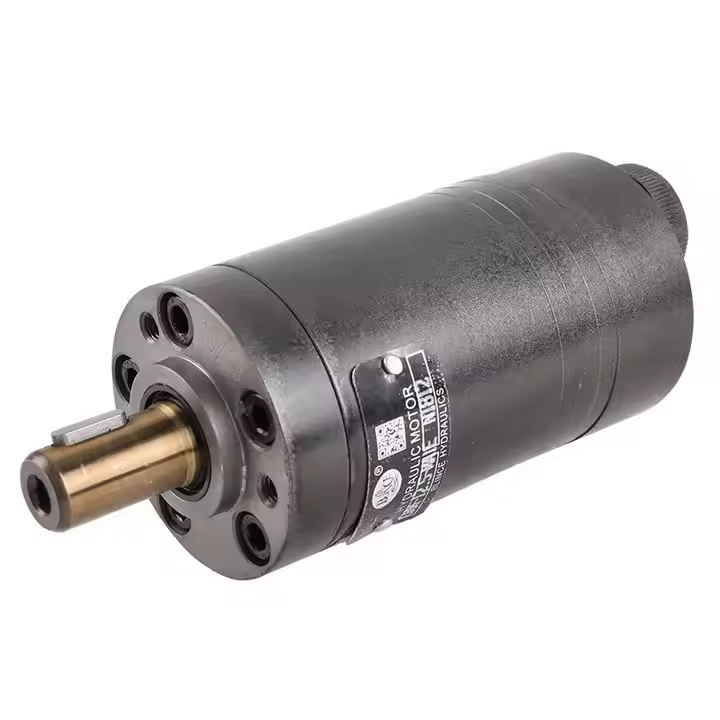
Have you ever wondered if a hydraulic pump can double as a motor? While both components work with hydraulic fluid, they serve very different functions. In this article, we’ll discuss whether a hydraulic pump can be used as a motor, why it might work in some cases, and why a dedicatedhydraulic motoris often the better choice. You’ll learn about the key differences, the limitations of using a pump as a motor, and when it’s best to choose a hydraulic motor for your needs.
What Are Hydraulic Motors and Hydraulic Pumps Designed to Do?
What is a hydraulic pump, and what job does it perform?
A hydraulic pump is a device that moves fluids in a hydraulic system by converting mechanical energy into hydraulic energy. In simple terms, it pushes liquid under high pressure through the system, creating flow. The pump's primary purpose is to generate hydraulic pressure and flow that is essential for operating various machinery. Without a pump, a hydraulic system would lack the energy required to move fluids and power machinery, such as lifts, presses, or any system requiring force and motion.
Hydraulic pumps come in different types, such as gear pumps, piston pumps, and vane pumps. Each type of pump operates slightly differently, but their core function remains the same: to supply the hydraulic fluid at a specific pressure to power the connected systems. In systems where high force and smooth operation are needed, such as in construction equipment or industrial machinery, pumps are essential for creating the right pressure and flow.
What are hydraulic motors, and how do they create output motion?
Hydraulic motors, in contrast to pumps, convert hydraulic energy back into mechanical energy. Essentially, they take the pressurized hydraulic fluid supplied by a pump and turn it into rotary motion. This motion is used to drive machinery and various applications such as conveyors, mixers, or wheels in mobile equipment.
The core function of a hydraulic motor is to produce torque (the force that causes rotational movement) and speed based on the fluid’s pressure and flow rate. For instance, in a hydraulic motor, the higher the pressure, the greater the torque produced. Different hydraulic motors are designed to handle varying amounts of torque and speed, and they are selected based on the requirements of the application. Hydraulic motors can be found in heavy-duty machinery, from agricultural machines to industrial systems, where power and efficiency are crucial.
Hydraulic motors vs. pumps: what is the real difference?
While hydraulic motors and hydraulic pumps seem to share similar principles of operation, they serve very different roles in hydraulic systems. The key difference lies in the direction of energy conversion. A hydraulic pump creates fluid flow by converting mechanical energy (from a motor or engine) into hydraulic pressure, whereas a hydraulic motor uses pressurized fluid to produce rotary mechanical motion, thereby converting hydraulic energy into mechanical work.
Both components work with hydraulic fluid, but their design purposes are opposite. A pump is designed to move fluid to create pressure, while a motor is designed to use that pressure to do work, typically turning a shaft. This key difference is why a pump is not generally interchangeable with a motor in most hydraulic systems, even though they might appear structurally similar in some cases.
To make it clearer, let’s summarize the major differences:
Aspect
Hydraulic Pump
Hydraulic Motor
Function
Converts mechanical energy into hydraulic energy
Converts hydraulic energy into mechanical energy
Primary Purpose
Generates flow and pressure
Generates rotational output (torque, speed)
Energy Conversion
Mechanical energy → Hydraulic energy
Hydraulic energy → Mechanical energy
Common Applications
Presses, lifts, construction machines, etc.
Conveyors, mixers, wheels, industrial equipment
Can a Hydraulic Pump Really Work Like Hydraulic Motors?
The short answer: yes, but only in limited cases
Yes, technically, a hydraulic pump can work like a hydraulic motor, but this only happens under specific circumstances.
The concept of reverse operation in pumps involves using hydraulic fluid to drive the pump’s shaft, converting hydraulic pressure into rotational movement.
However, while it may be possible, using a hydraulic pump as a motor is not ideal for most industrial applications. The efficiency and output torque are significantly compromised compared to using a dedicated hydraulic motor.
How can a hydraulic pump rotate when fluid is forced through it?
A hydraulic pump operates by converting mechanical energy into hydraulic energy to move fluid under pressure. In reverse, the pressurized fluid can force the internal components of the pump, like gears or vanes, to rotate. Here’s how this reverse energy conversion works:
Pressure-driven rotation: When fluid enters the pump under pressure, the internal components, such as the gears or pistons, begin to rotate, just like they would in a hydraulic motor.
Comparing to hydraulic motors: Hydraulic motors work similarly in that they use pressurized fluid to produce rotational motion. However, unlike motors, pumps are not optimized for continuous motion, and their design is focused on fluid displacement, not mechanical output.
This difference in design explains why a hydraulic pump, when used as a motor, will generally perform poorly compared to a dedicated hydraulic motor.
Why a hydraulic pump is not a true substitute for hydraulic motors
While it may seem practical to use a hydraulic pump as a motor in certain situations, there are significant limitations:
Not optimized for motor duty: Hydraulic pumps are designed to move fluid and create pressure, not to generate consistent torque. When forced to rotate, their performance deteriorates, resulting in lower efficiency and reduced power output.
Temporary solution, not a long-term fix: A pump working as a motor can suffice for occasional, light-duty applications, but it will fail to provide reliable, continuous performance. In heavy-duty or industrial applications, it’s simply not built for long-term motor use.
Efficiency concerns: Pumps that operate in reverse tend to suffer from high internal leakage, friction, and wear, which are not issues for motors designed to endure high torque and continuous use.
Are some pump types more likely to work than others?
Not all pumps are created equal when it comes to being used as motors. Some pump types are more likely to function when run in reverse due to their design characteristics:
Gear pumps: Gear pumps are more commonly used as motors in reverse, thanks to their simpler internal structure. They can handle light-duty applications where efficiency and torque requirements are not as demanding.
Vane pumps: Vane pumps, although efficient, are less suited for reverse operation due to their higher internal leakage and design limitations.
Piston pumps: These are the least likely to work effectively as motors, as their high pressure and fluid displacement requirements make them inefficient for reverse operation.
Pump Type
Likelihood of Working as a Motor
Applications
Gear pumps
Most likely to work in reverse
Light-duty, intermittent use
Vane pumps
Moderate likelihood
Light-duty, small torque tasks
Piston pumps
Least likely to work in reverse
High-pressure, continuous applications
This table helps clarify which pump types are more suited for temporary motor-like use and which should be avoided for such purposes.
What Limits a Pump When It Is Used Instead of Hydraulic Motors?
Efficiency, torque, and speed: where performance starts to fall short
When a hydraulic pump is used as a motor, it often underperforms compared to dedicated hydraulic motors. The primary reason for this is efficiency loss. Pumps are not designed to generate sustained torque or control speed effectively in reverse. As a result, when used as a motor, they generally exhibit:
Lower usable torque: Hydraulic pumps are designed to generate pressure and flow, not torque. This means that when used as a motor, the output torque is much lower than that of a motor designed specifically for high torque.
Speed control issues: Pumps are typically better suited for creating fluid movement at consistent pressure. However, when used as a motor, controlling speed becomes difficult, and the system may be less responsive to changes in load or flow.
These limitations can significantly affect real-world applications, especially in industries where high efficiency and reliable speed control are essential, such as in construction machinery or industrial processes.
Internal leakage, porting, and rotation direction problems
Hydraulic pumps are designed to create pressure and flow, not to maintain constant rotational movement under load. This leads to several issues when they are used as motors:
Internal leakage: When a pump is forced to operate in reverse, it often suffers from internal leakage due to design characteristics. This can reduce performance and cause the pump to waste energy, leading to inefficiency.
Porting: The way fluid enters and exits the pump is critical to its operation. In most pumps, ports are designed for fluid entry, not for reversing the flow to generate movement. Improper porting in reverse operation can lead to performance degradation and even damage.
Rotation direction: Pumps and motors are designed for specific rotation directions. Using a pump as a motor can lead to misalignment issues, especially if the rotation is not as intended, affecting overall reliability.
These problems emphasize why pumps are not designed to work as motors in most heavy-duty applications.
Wear, duty cycle, and service life concerns
The duty cycle and service life of a pump when used as a motor are key factors in its overall performance. Here’s why:
Intermittent use vs. continuous operation: Pumps are typically used for intermittent duty cycles. They are not designed for continuous operation, and when used as motors for prolonged periods, they experience excessive wear.
Bearing load: As a motor, the pump is subjected to high rotational forces that it was not built to handle. The bearing load increases, leading to faster wear and tear.
Maintenance: The added strain of working as a motor can cause pumps to require more frequent maintenance and shorter service life. While a hydraulic motor is built to endure high stress over time, a pump working in reverse tends to wear out more quickly.
These issues demonstrate why using a hydraulic pump as a motor is not recommended for high-duty applications.
Safety and system matching risks readers should not ignore
When replacing a hydraulic motor with a pump, it’s crucial to consider system compatibility and safety:
Pressure, displacement, and shaft load: These factors must align with the system’s requirements. A pump that is not designed to handle the high torque and pressure generated by a motor could cause system failure or inefficiency.
Operating conditions: The operating environment, such as temperature and pressure, needs to be factored in when considering using a pump in place of a motor. Without proper matching, the pump may fail or perform poorly under the expected load.
Safety concerns: Inappropriate system matching could lead to dangerous situations, such as overheating, malfunctioning, or system failure. It’s important to assess whether a pump can truly perform the tasks of a motor safely.
When Should You Choose Dedicated Hydraulic Motors Instead?
When a pump-as-motor setup may be acceptable
While using a pump as a motor can seem like a practical workaround, it’s only acceptable in limited scenarios:
Light-duty applications: If the load is not demanding and the operation is intermittent, a pump may suffice in short bursts.
Lower torque requirements: When the required torque is relatively low, a pump can sometimes generate enough output in reverse.
Single-direction rotation: Pumps working in reverse are usually only suitable for operations that require rotation in one direction.
Intermittent operation: If the pump is used for only short, non-continuous cycles, it can sometimes function as a motor without causing major issues.
However, these scenarios represent compromise solutions, and the performance is typically suboptimal compared to a true hydraulic motor. For any long-term or heavy-duty application, this setup is generally not recommended.
When dedicated hydraulic motors are the better choice
Hydraulic motors are specifically designed for tasks requiring high performance, torque, and durability. They should be chosen in the following situations:
High torque requirements: Hydraulic motors are designed to provide high torque at low speeds, which is crucial for heavy-duty applications like material handling, construction equipment, and mining machinery.
Low-speed, heavy-duty work: Hydraulic motors are engineered to maintain stable, controlled movement under high-load conditions. Unlike pumps, motors are built for this purpose.
Continuous service: Hydraulic motors are designed for continuous operation and can withstand prolonged use without degrading performance.
Stable speed and control: Dedicated motors allow for precise speed control and stable operation, even under varying loads.
In contrast to pumps, hydraulic motors are optimized to meet these demands efficiently and reliably, which is why they should be the choice in industrial, agricultural, and construction applications where consistent performance is necessary.
Which Blince hydraulic motors are relevant to different applications?
Blince offers a wide range of hydraulic motors, each designed for specific applications. Here’s a breakdown of the most relevant models and when they should be used:
Hydraulic Orbital Motors: Best for compact systems where space is limited. They are commonly used in machinery that requires general power transmission like conveyors, fans, and small construction equipment.
Hydraulic Radial Piston Motors: These are the go-to solution for low-speed, high-torque applications such as tunnel boring machines, excavators, and piling rigs. They deliver exceptional performance under heavy load conditions.
Hydraulic Axial Piston Motors: Used in heavy-duty systems requiring higher efficiency. These motors are suitable for industrial and mobile applications where high power output and efficiency are critical, like cranes or agricultural machinery.
Hydraulic Gear Motors: Ideal for compact, high-speed applications. These motors are commonly found in small machinery where space constraints are a concern, offering consistent and reliable power in systems like pump drives or material handling units.
Motor Type
Best For
Common Applications
Orbital Motors
Compact systems, general drive needs
Conveyors, fans, small construction machinery
Radial Piston Motors
Low-speed, high-torque applications
Tunnel boring machines, excavators, pile drivers
Axial Piston Motors
Heavy-duty, high-efficiency systems
Cranes, agricultural equipment
Gear Motors
Compact, high-speed operations
Pump drives, material handling systems
Conclusion
This article explores whether a hydraulic pump can be used as a motor. While technically possible, it is not ideal for most applications. Pumps are designed for fluid movement, while hydraulic motors are built to convert hydraulic energy into rotary motion. Using a pump as a motor compromises efficiency, torque, and performance. Dedicated hydraulic motors, like those offered by Blince,provide better reliability, higher torque, and long-term durability for heavy-duty tasks. Blince's product range, including orbital and radial piston motors, ensures that customers get reliable solutions tailored to their needs.
FAQ
Q: Can a hydraulic pump be used as a motor?
A: Yes, but only in limited applications. The performance is usually much lower than that of a dedicated hydraulic motor.
Q: What is the difference between hydraulic pumps and hydraulic motors?
A: Pumps move fluid to create pressure, while hydraulic motors convert that pressure into mechanical movement.
Q: When is it better to use a hydraulic motor instead of a pump?
A: Hydraulic motors are better for applications requiring continuous operation, high torque, and precise speed control.
Q: What are the advantages of hydraulic motors?
A: Hydraulic motors provide high efficiency, consistent torque, and are built for long-term durability in heavy-duty operations.
Q: What type of hydraulic motors does Blince offer?
A: Blince offers a range of hydraulic motors, including orbital, radial piston, and gear motors, designed for different applications and efficiency needs.