Whether it's a mini excavator digging a trench in Texas, a combine harvester rolling across the wheat fields of Queensland, or an offshore crane swinging cargo above the North Sea — all of these machines share one thing: they rely on hydraulic motors to convert fluid power into precise mechanical rotation.
Despite their central role in modern machinery, hydraulic motors are often misunderstood or confused with hydraulic pumps. This guide breaks down exactly what a hydraulic motor is, how it works, the main types available today, and what engineers in construction, agriculture, mining, and marine industries need to know when selecting one.
1. What Is a Hydraulic Motor?
A hydraulic motor is a mechanical actuator that converts hydraulic pressure and flow into torque and rotational speed at its output shaft. It is the "output side" of a hydraulic drive system: the pump pressurizes the fluid, the control valves direct it, and the motor transforms that energy into continuous shaft rotation to do useful work.
Core Advantages of Hydraulic Motors
Advantage
Explanation
High power density
Very high torque from a compact body
Stepless speed control
Flow rate = speed; infinitely variable
Reversible rotation
Simply reverse fluid direction
Overload protection
System relief valves prevent damage
Harsh-environment durability
Works in dust, water, vibration, explosion-risk zones
2. How Does a Hydraulic Motor Work?
The operating principle follows Pascal's Law: pressure applied to a confined fluid transmits equally in all directions. In a hydraulic motor, high-pressure oil from the pump enters the inlet port and acts on the internal rotating element — creating a pressure differential that generates torque. The low-pressure return oil exits through the outlet port and flows back to the reservoir.
Key Performance Parameters
Parameter
Unit
Engineering Significance
Displacement
cc/rev
Volume of oil per revolution; governs torque/speed relationship
Rated pressure
bar / MPa
Maximum continuous operating pressure
Peak pressure
bar / MPa
Short-duration maximum (typically 30 s)
Rated speed
RPM
Continuous shaft speed range
Output torque
N·m
Actual rotational force at the shaft
Volumetric efficiency
%
Actual vs. theoretical flow utilization
3. The Six Main Types of Hydraulic Motors
3.1 Hydraulic Orbital Motor (Gerotor / Cycloid Motor)
The orbital motor — also called a gerotor or cycloid motor — uses a matched inner rotor and outer ring gear based on the trochoidal curve. As high-pressure oil enters, the rotor orbits within the ring gear, producing a low-speed, high-torque output from a very compact package. It is one of the most widely used motor types in the world.
The Geroler gear set design — used in the OMT-315 series orbital hydraulic motor — adapts disc distribution flow for reliable high-pressure operation and supports multiple shaft and port configurations to suit different machine interfaces.
In a radial piston motor, multiple pistons are arranged radially around a central crankshaft or cam ring. Hydraulic pressure pushes each piston outward in sequence, rotating the cam. The result is extremely high torque at very low speeds — as low as 1–5 RPM in some models — without requiring a reduction gearbox. This makes them the definitive Low-Speed High-Torque (LSHT) solution.
The IAM Series radial piston motor is specifically engineered for slewing, winching, mining, marine, and industrial direct-drive systems where reliability, smooth low-speed motion, and long service life are non-negotiable.
The LD series (LD1 through LD70) covers a broad displacement and torque spectrum, all manufactured in high-quality cast iron and certified to ISO 9001:2015, CE, FSC, and SGS standards. The LD-series low-speed high-torque radial piston motor range — from the compact LD1 to the heavy-duty LD70 — handles rated pressures from 16 to 25 MPa with peak pressures up to 35 MPa.
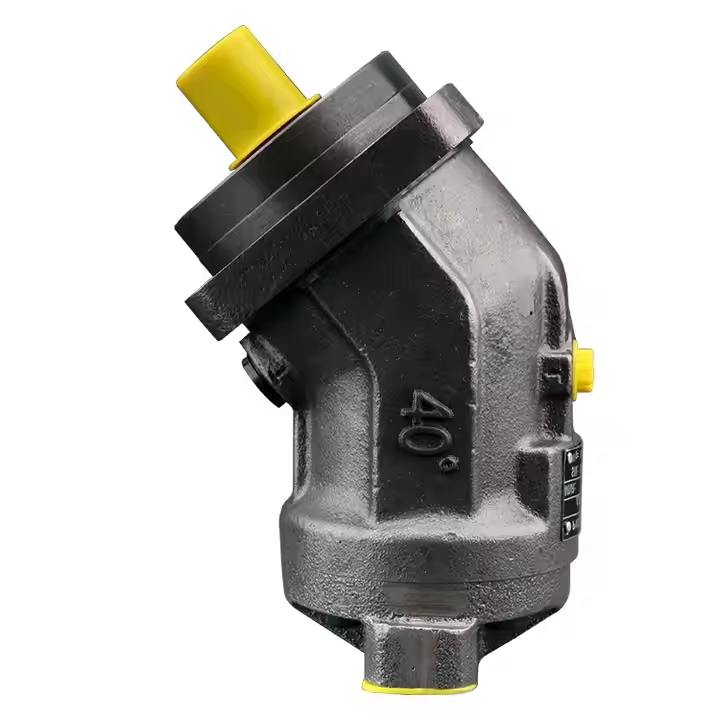
In an axial piston motor, pistons are arranged parallel to (or at a fixed angle to) the output shaft. As high-pressure oil acts on each piston, it pushes against an angled swashplate (swashplate design) or a bent-axis cylinder block (bent-axis design), converting linear piston force into shaft rotation. This type achieves the highest overall efficiency of all hydraulic motor designs — typically above 92–95% — and is well-suited to high-speed, high-pressure circuits.
Variable displacement axial piston motors allow dynamic adjustment of the displacement angle, enabling the system to automatically shift between high-torque/low-speed and low-torque/high-speed modes — the foundation of modern hydrostatic transmission (HST) systems found in agricultural tractors from manufacturers in Europe, North America, and Asia.
Common applications: Hydrostatic drives in tractors and combines, hydraulic presses, wind turbine pitch control, high-speed machine tool drives, closed-loop transmission systems
3.4 Hydraulic Gear Motor
The gear motor is the simplest hydraulic motor design: two external (or internal) gears mesh inside a precision housing. High-pressure oil enters on one side, forces the gears to rotate, and exits on the low-pressure side. Its design advantages — low cost, tolerance for contaminated oil, high shaft speeds, and easy maintenance — make it the go-to choice for medium-pressure auxiliary circuits worldwide.
The aluminum-body hydraulic gear motor provides a compact, lightweight option widely used on agricultural sprayers, cooling fan circuits, and industrial conveyor systems, while the cast-iron G Series and GM5 Series gear hydraulic motors are engineered for higher pressure and more demanding duty cycles in mobile machinery and industrial equipment.
Typical working parameters:
Displacement range: 1–250 cc/rev
Rated pressure: up to 25 MPa
Speed range: 200–4000 RPM
Common applications: Cooling fan drives, power steering, auger drives, mixer drums, conveyor motors, hydraulic power packs
3.5 Hydraulic Travel Motor
The hydraulic travel motor is a purpose-built, integrated drive unit that combines an orbital or axial piston motor with a planetary reduction gearbox and a spring-applied, hydraulically released parking brake — all in a single, bolt-on assembly. This integration eliminates the need for external drive components and makes the travel motor a plug-and-play drive module for tracked and wheeled machines.
Many travel motors offer two-speed switching: at high displacement (low speed), maximum drawbar pull is available for digging, climbing, or pushing; at low displacement (high speed), the machine can travel faster across the job site. The MSE Series and MS Series hydraulic travel motor — certified to ISO 9001:2015, CE, and SGS — are designed for direct wheel and track drives in compact to medium-duty excavators, crawler carriers, and aerial work platforms.
Common applications: Mini and compact excavators (1–10 ton), crawler dumpers, tracked aerial platforms, agricultural harvesters, underground mining vehicles
3.6 Hydraulic Orbit Motor with Integrated Brake
A specialized evolution of the standard orbital motor, the hydraulic orbit motor with brake integrates a spring-applied holding brake into the motor body. When hydraulic pressure is released, the brake automatically engages, locking the output shaft and preventing unintended load movement — a critical safety feature for winches, suspended loads, and slewing equipment.
The BMRS/OMRS series orbit motor with advanced Geroler gear set features automatic pressure compensation during operation for reliable, smooth performance at high pressure and extended service life — equivalent to and interchangeable with Eaton Char-Lynn S-series motors.
Similarly, the OMR-BK01 and BMR-BM01 series extend the standard OMR motor range with an integrated holding brake, providing a safety lock for vertical axis or suspended load applications — crane slew drives, vertical conveyor systems, and positioning actuators.
Common applications: Crane slewing and hoisting, vertical axis winches, agricultural front loaders, forestry equipment, industrial positioning systems
4. How to Choose the Right Hydraulic Motor
Selecting the wrong motor type is one of the most common and costly engineering mistakes in hydraulic system design. The following framework helps narrow down the right choice.
Step 1 — Define Load Requirements
Calculate the required output torque (T) and speed (n):
Step 2 — Match Motor Type to Application Profile
Requirement
Best Motor Type
Very low speed (< 50 RPM), very high torque, no gearbox
Radial Piston (LSHT)
High speed (> 1000 RPM), maximum efficiency, variable speed
Axial Piston
Compact size, medium torque, 10–900 RPM
Orbital (Gerotor)
Simple circuit, contaminated oil tolerance, high speed
Gear Motor
Integrated wheel/track drive with brake and gearbox
Travel Motor
Holding brake required for suspended or slewing loads
Orbital Motor with Brake
Step 3 — Consider Environmental Factors
Oil cleanliness: Gear motors tolerate ISO 4406 class 20/18/15 or worse; piston motors require 17/15/12 or better.
Temperature range: Seal compound must match ambient extremes (-40°C to +120°C in most cases).
Mounting: Flange (SAE, ISO), foot-mount, or wheel-hub integrated — confirm interface before ordering.
Fluid type: Confirm compatibility for fire-resistant fluids (HFA/HFB/HFC/HFD) if required by safety regulations.
5. Global Industries That Depend on Hydraulic Motors
Construction & Earthmoving
From the booming infrastructure projects in Southeast Asia to road construction across the American Midwest, hydraulic travel motors and slew drives are the backbone of every tracked machine. A standard 5-ton compact excavator uses at least two independent travel motors plus one slew motor — three precision hydraulic rotary actuators working in coordination on every job site.
Agricultural Machinery
In grain-growing regions from the Canadian Prairies to the Ukrainian Black Earth Belt to the Australian wheat belt, modern combine harvesters rely on orbital hydraulic motors to drive everything from grain augers to header reels to threshing drums — often six to twelve motor-driven functions per machine. The lightweight aluminum gear motor drives auxiliary systems like hydraulic cooling fans, reducing total machine weight while maintaining performance.
Mining & Tunneling
Underground mine equipment in Western Australia, South Africa, and the Canadian Shield demands motors that survive shock loads, extreme contamination, and continuous duty cycles. Radial piston LSHT motors directly drive haul truck wheels, continuous miners, and rock drill rotation without intermediate gearboxes — reducing mechanical complexity in environments where maintenance access is difficult and costly.
Marine & Offshore
Offshore platforms in the Gulf of Mexico and North Sea require hydraulic motors certified for salt spray resistance and capable of operating at extreme pressures (up to 350 bar) in continuous duty. Orbital motors drive anchor windlasses, mooring winches, and deck cranes, while radial piston motors power thrusters on dynamic positioning (DP) vessels.
6.Maintenance Essentials for Hydraulic Motors
Hydraulic motors are highly reliable components when operated within their rated parameters. Most premature failures share a handful of root causes:
Failure Cause
Symptom
Prevention
Fluid contamination
Abnormal wear, reduced efficiency
Maintain ISO 16/14/11 oil cleanliness
Cavitation
Noise, surface pitting, power loss
Check inlet pressure; avoid overspeeding
Overpressure
Seal extrusion, fatigue cracks
Verify relief valve settings
Shaft seal failure
External leakage
Inspect regularly; replace at first sign
Wrong fluid viscosity
High running temperature, reduced film
Match ISO VG grade to temperature range
Recommended maintenance intervals:
Every 500 operating hours: check oil cleanliness and shaft seal for leaks
Every 1,000 hours: change hydraulic oil and filters (or per system monitoring data)
Every 2,000 hours or annually: full system inspection including motor case drain flow check
FAQ
Q1: What is the difference between a hydraulic motor and a hydraulic pump?
Both devices are geometrically similar and use the same internal mechanisms (gears, pistons, vanes). The difference is in energy direction: a pump converts mechanical shaft rotation into fluid power (pressure + flow), while a motor does the reverse — it converts fluid power into mechanical shaft rotation. Some hydraulic motors can function as pumps when driven in reverse, but they are not optimized for self-priming or suction conditions.
Q2: What does "low-speed high-torque" (LSHT) mean and which motor type achieves it best?
LSHT refers to the ability to deliver high output torque at very low shaft speeds (typically 1–400 RPM) without an intermediate gearbox. Radial piston motors are the prime LSHT solution, capable of producing thousands of Newton-meters of torque while rotating as slowly as 1–5 RPM. Orbital (gerotor) motors also fall into the LSHT category at their lower speed range (10–100 RPM), though at lower torque levels than radial piston designs.
Q3: Can hydraulic motors run in both forward and reverse directions?
Yes. Most hydraulic motors are inherently bidirectional. Reversing the direction of oil flow — achieved simply by switching a directional control valve in the hydraulic circuit — reverses the direction of shaft rotation. This makes hydraulic drives significantly simpler to reverse than electric motor drives, which require inverters or contactors for direction control.
Q4: What hydraulic fluid should I use with a hydraulic motor?
Most hydraulic motors are designed for mineral-based hydraulic oil. The correct ISO VG grade depends on ambient temperature: ISO VG 32 for cold climates (< 0°C operating), ISO VG 46 for temperate conditions (general-purpose), and ISO VG 68 for hot climates or high-load applications. Always check the manufacturer's data sheet for seal material compatibility before using fire-resistant fluids (HFA, HFB, HFC, HFD types) or biodegradable oils.
Q6: What certifications should a reliable hydraulic motor manufacturer hold?
The baseline certifications for global markets are ISO 9001 (quality management system), CE (European conformity for safety and environmental requirements), and SGS (third-party quality verification). Additional certifications such as FSC (material chain of custody) and marine-class approvals (ABS, BV, DNV) are required for specialized applications in timber, offshore, and marine sectors.
Q5: How long does a hydraulic motor typically last?
A properly maintained hydraulic motor operating within its rated parameters typically achieves 8,000–20,000+ hours of service life. Gear motors generally have shorter design lives (8,000–12,000 hours) due to higher internal wear rates, while high-quality axial piston and radial piston motors can reliably exceed 15,000–20,000 hours when oil cleanliness is maintained and the motor is not operated at sustained peak pressure. The leading cause of premature failure in field surveys is consistently hydraulic oil contamination above the manufacturer's specified cleanliness level.
Q6: What is the difference between a hydraulic slewer motor and a travel motor?
Both are specialized hydraulic motor assemblies, but they serve entirely different motion functions. A hydraulic slew motor drives the rotation of a superstructure around a vertical axis (e.g., the cab and boom of an excavator rotating 360° relative to the undercarriage). A hydraulic travel motor drives the linear movement of the machine by turning its tracks or wheels. Slew motors emphasize smooth acceleration/deceleration and precise stop positioning; travel motors emphasize maximum tractive force (drawbar pull) and often incorporate two-speed switching.