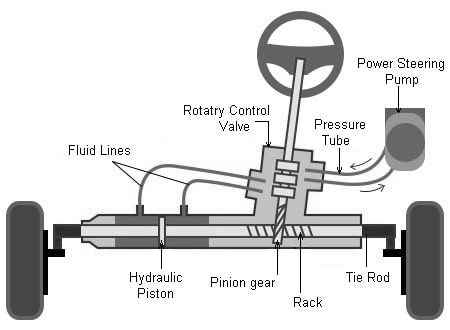
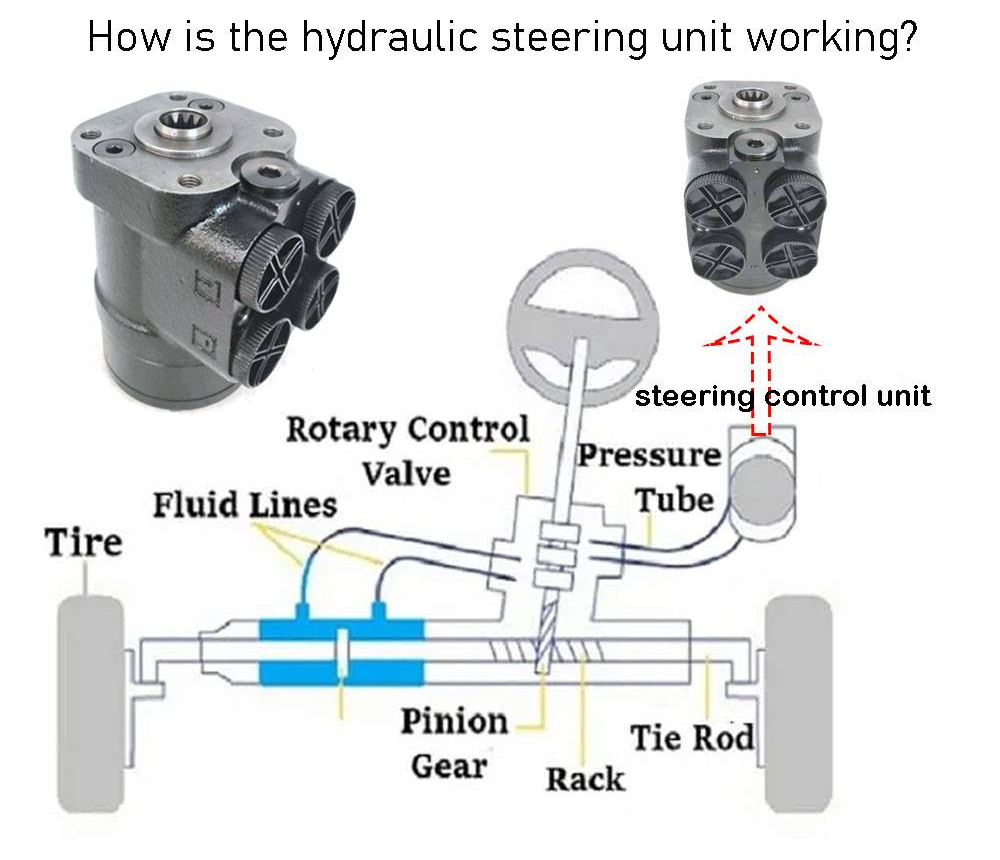
In mobile machines such as tractors, loaders and forklifts, the hydrostatic steering unit (SCU) is the heart of the control system. By using hydraulic power instead of mechanical linkages, it delivers smooth, precise and low‑effort steering. Inside the SCU are a rotary valve and a metering element. These connect via a steering column to the steering wheel; when the operator turns the wheel, the system’s pump sends pressurized oil through the rotary valve, which meters flow to port L or R and on to the steering cylinder. This design ensures that steering response matches the steering‑wheel angle, helping large machines operate safely and efficiently.
Differences Between Open‑ and Closed‑Centre Units
Hydraulic steering systems operate in two main modes—open‑centre and closed‑centre—which differ markedly in fluid flow and circuit configuration:
Feature / System
Open‑centre system
Closed‑centre system
Flow at rest
Continuous flow
No flow
Pump type
Fixed‑displacement pump
Variable‑displacement or load‑sensing pump
Efficiency
Lower
Higher
System complexity
Simple design
More complex
Multi‑function support
Limited
Excellent
Typical use
Basic, lower‑cost equipment
High‑performance machines
Open‑centre systems maintain flow even when the machine is idle, making them suitable for low‑cost, light‑duty equipment. Closed‑centre systems use load‑sensing control and only supply flow when steering is required; they are more efficient and better suited to high‑end machinery requiring multi‑function control. Which one you choose depends on your machine’s purpose and budget.
Do Hydraulic Steering Systems Require External Power?
Hydraulic steering units rely entirely on hydraulic power; no auxiliary electrical power is needed. Pressure oil from a pump drives the system. The pump is usually mechanically driven by the engine via belt, gear or shaft, so these systems do not need external electricity. For added safety, many designs include a limited manual steering function. If pump pressure is lost, the operator can still steer within limits using built‑in mechanical reaction or a hand‑pump action.
Steering Feedback: Reaction vs Non‑Reaction
Whether the steering wheel gives feedback depends on the unit selected:
Non‑reaction units: These do not transmit road or load feedback to the steering wheel; the operator feels “isolated”, and the wheel will not self‑centre when external forces act on it.
Reaction / load‑reactive units: These provide natural feedback when system pressure changes, enabling the operator to sense ground conditions and giving the wheel self‑centering ability.
The rule of thumb is: if a unit is labelled “No‑Reaction” or “Non‑Reaction” it will not provide feedback; if you want road feel, choose a “reaction” or “load‑reactive” unit.
Selecting the Right Steering Unit for Your Machine
Choosing the right hydraulic steering unit requires considering the machine type, hydraulic system design and operating environment:
Machine type and application – Agricultural tractors typically use load‑sensing or reaction/non‑reaction units; forklifts and telehandlers need compact, low‑displacement, often non‑reaction units; construction equipment favours high‑displacement, reaction units; ATVs require lightweight, responsive non‑reaction units; road vehicles usually select closed‑centre systems with feedback.
Hydraulic system type – Match your steering unit to your system: open‑centre systems supply constant flow for simpler machines; closed‑centre systems provide on‑demand flow in more complex, load‑sensing circuits; load‑sensing systems adjust flow and pressure based on steering demand.
Reaction vs non‑reaction – Reaction units return ground feedback to the steering wheel, useful for operators who need road feel or manual override, common in construction and road vehicles; non‑reaction units isolate vibrations and prevent kickback, ideal for off‑road and agricultural machinery.
Displacement (cc per revolution) – Displacement determines the volume of fluid moved per turn of the wheel; choose based on the speed and force required to turn the wheels.
Mounting and port configuration – Check flange types (SAE, DIN), port sizes and thread types (BSP, SAE, metric) to ensure compatibility with your existing circuit.
Are Hydraulic Steering Systems Suitable for High‑Speed Vehicles?
Hydraulic steering systems are not naturally suited to high‑speed vehicles because they lack road feel, respond more slowly and may pose safety risks. However, through advanced designs and redundancy, they can be used in certain high‑speed specialty vehicles—military transporters, heavy‑duty trucks, airport fire engines and off‑road racing vehicles. These systems typically feature reaction‑type steering valves for feedback, closed‑centre load‑sensing hydraulics for responsive control, and backup pumps or mechanical overrides to improve safety and reliability.
Information Required to Order a Replacement Steering Unit
To ensure compatibility and performance, the following technical and application details are needed when ordering a replacement steering unit:
Identification: model, serial number and manufacturer.
Specifications: displacement, reaction type, centre type (open/closed) and porting.
Mounting requirements: bolt pattern, flange size and shaft type.
Application: machine model and operating environment.
System information: operating pressure, flow and pump type.
Note that some steering units integrate load‑sensing or priority valves, but not all do; check the product specifications carefully before ordering.
Why Choose Blince’s Hydraulic Steering Solutions
As a specialist in hydraulic technology, Blince offers complete hydraulic solutions across agricultural, engineering and industrial sectors. Our steering units are made from top‑quality materials, ensuring durability and outstanding performance even in demanding conditions. We supply a comprehensive range of pumps, valves, cylinders, hoses and fluid‑control systems. For specific applications, we can provide custom power units and complete system solutions. Whether you need standard products or bespoke designs, Blince’s engineering experience and advanced production equipment enable us to deliver reliable, high‑efficiency hydraulic steering solutions.
Choosing Blince technology means choosing efficiency, durability and professionalism in every hydraulic product. Visit our official website for more product details or contact our engineering team for professional advice.