Fluid power has been used to transmit mechanical energy for well over a century, yet hydraulic motor technology continues to evolve in ways that matter to modern engineers. Advances in Geroler gear geometry, multi-piston camring design, and integrated planetary gearbox engineering have steadily expanded the envelope of what hydraulic motors can do — pushing torque density higher, minimum stable speeds lower, and service intervals longer. For engineers specifying drive systems across construction equipment, agriculture, marine, mining, and industrial automation, staying current with what each motor architecture genuinely offers — and where each one falls short — is the foundation of good system design.
This article approaches hydraulic motors from an engineering decision perspective. It explains the physical principles that govern motor behavior, examines the trade-offs each design family makes, provides a structured framework for matching motors to applications, and addresses the regional regulatory and sourcing considerations that shape procurement decisions across global markets.
Fluid Power Fundamentals: How Hydraulic Motors Convert Energy
A hydraulic motor receives pressurized fluid and converts the energy stored in that pressure differential into mechanical shaft rotation. The energy conversion follows conservation of energy principles, with losses attributable to fluid leakage (volumetric losses) and mechanical friction (mechanical losses).
The Core Performance Relationships
Three equations define the theoretical performance of any hydraulic motor:
Theoretical torque (Nm) = q × ΔP × 0.1 ÷ (2π) where q = geometric displacement in cm³/rev, ΔP = pressure differential in bar
Theoretical speed (rpm) = Q × 1,000 ÷ q where Q = volumetric flow rate in L/min
Theoretical power (kW) = T × n ÷ 9,549 where T = torque in Nm, n = speed in rpm
Real-world performance deviates from these ideal values due to:
Volumetric losses: Internal leakage from high-pressure to low-pressure zones across seals, valve plates, and internal clearances. Expressed as volumetric efficiency (η_v), typically 90–98% for well-manufactured piston motors, 85–93% for orbital motors.
Mechanical losses: Friction in bearings, seals, and sliding contact surfaces. Expressed as mechanical efficiency (η_m), typically 88–95% for piston motors, 85–92% for orbital motors.
Overall efficiency: η_overall = η_v × η_m. For well-designed piston motors at their rated operating point, overall efficiency of 88–92% is achievable; for gear motors, 78–85% is more typical.
These efficiency differences become economically significant when motors run continuously. A 5-percentage-point efficiency difference on a 30 kW drive running 4,000 hours per year represents approximately 6,000 kWh of energy — a meaningful operating cost gap over a machine's service life.
Pressure, Displacement, and the Torque-Speed Trade-off
Every hydraulic motor selection involves a fundamental trade-off: for a fixed fluid power input (pressure × flow), increasing displacement produces more torque and less speed, while decreasing displacement produces less torque and more speed. This is not a limitation of any particular design — it is a consequence of energy conservation.
The practical implication is that motor selection cannot be separated from system pressure and flow capacity. An engineer who specifies a motor purely on torque output, without verifying that the required flow rate is within the pump's capacity and that the required pressure is within the system's rated operating range, will inevitably encounter problems during commissioning.
Hydraulic Motor Design Families: Architecture, Trade-offs, and Operating Envelopes
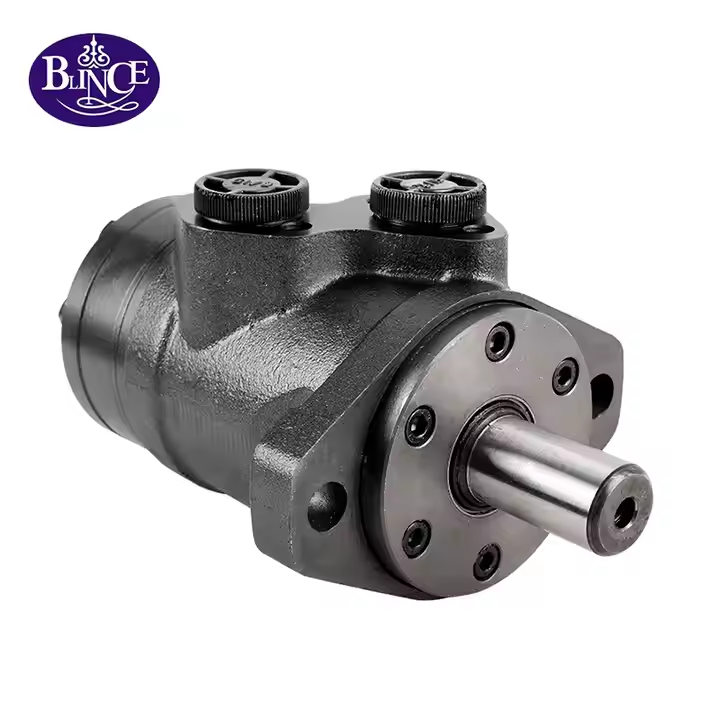
Orbital (Geroler) Motors
How They Work
An orbital motor uses a planetary gear set consisting of an inner rotor with n teeth and an outer ring gear with n+1 teeth. As high-pressure fluid fills the expanding chambers formed between the lobes, it forces the inner rotor to orbit eccentrically. This orbital motion is converted to shaft rotation through a cardan shaft or direct spline coupling. The continuous, overlapping nature of the lobe chamber filling and emptying produces a relatively smooth torque output — though at high displacement, some torque ripple is inherent in the design.
Two Porting Approaches
The way hydraulic fluid is timed to each lobe chamber defines two distinct orbital motor sub-categories:
Disc distribution uses a flat rotating valve plate that turns synchronously with the gear set to connect each lobe chamber alternately to the high-pressure inlet and the low-pressure outlet. This approach is inherently self-compensating for wear because the valve plate is loaded axially by system pressure. The OMT Series Geroler orbital motor uses this disc distribution principle with an advanced Geroler gear set designed for high-pressure operation, configurable in individual variants for multifunctional application requirements.
The BMK2 disc-distribution orbital motor follows the same design logic and is geometrically equivalent to the Eaton Char-Lynn 2000 series (104-xxxx-xxx), offering engineers a direct cross-reference for systems originally built around that platform. Like the OMT Series, it uses an advanced Geroler gear set with disc distribution flow and high-pressure design, configurable for individual multifunctional operating variants.
Shaft distribution routes pressurized fluid through drillings in the output shaft itself, eliminating the valve plate and simplifying the internal arrangement for certain mounting orientations. The OMRS Series shaft-distribution orbital motor uses this approach. It is equivalent to the Eaton Char-Lynn S 103 series and incorporates a Geroler gear set that automatically compensates for internal wear under high-pressure operation — maintaining reliable, smooth performance and high efficiency over an extended service life without manual recalibration.
Performance Envelope and Limitations
Orbital motors typically operate in the speed range of 15–800 rpm, with displacement ranging from approximately 50 cm³/rev to 400 cm³/rev in standard configurations. Working pressure varies by model — the OMER Series orbit motor used widely in excavator and loader circuits is rated for 10.5–20.5 MPa continuous with 27.6 MPa peak, a pressure envelope suited to construction attachment duty. At the high-displacement end, the TMT V Series high-torque orbital motor achieves 400 cm³/rev with a 17-tooth splined output shaft, delivering the kind of powerful low-speed torque needed for crane slewing, heavy conveyor drives, and log handling without the mechanical complexity of a piston motor.
The inherent limitation of orbital motors is that minimum stable speed is higher than what radial piston motors achieve, and continuous high-load duty cycles generate more heat per unit of displacement than piston designs. For intermittent duty with moderate minimum speed requirements, these limitations are acceptable trade-offs for the cost and compactness advantages orbital motors offer.
Characteristic applications: construction attachment drive circuits, agricultural header and sprayer drives, marine deck accessories, conveyor line drives, material handling winches.
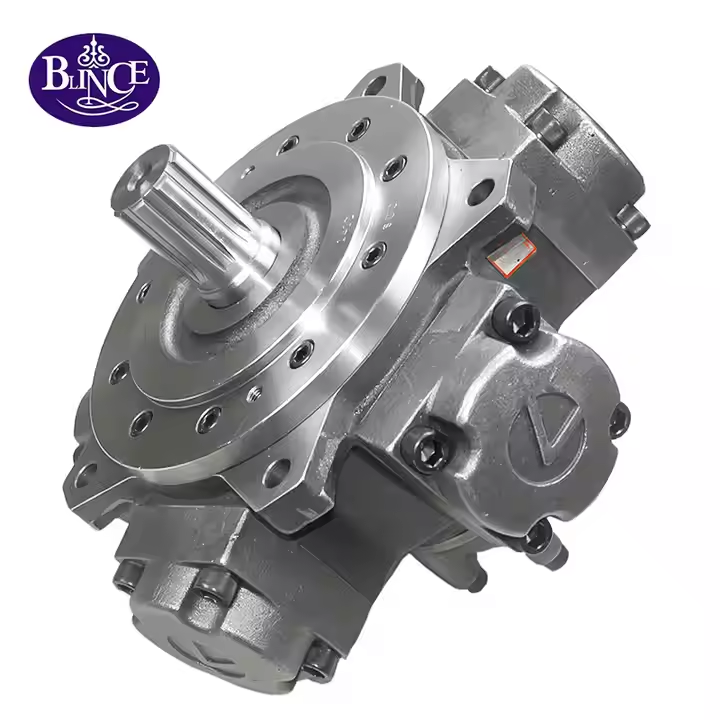
Radial Piston Motors
How They Work
Radial piston motors arrange multiple pistons — typically five, six, or eight — radially around a central crankshaft or eccentric camring. A timed valve arrangement (typically a spool valve or ported shaft) connects each piston chamber sequentially to the high-pressure supply and low-pressure return. The pressure force on each piston converts to a tangential force on the crankshaft through the piston-to-crankshaft geometric relationship, producing rotation.
Because multiple pistons are always in partial power stroke simultaneously, and their contributions are phased over the full 360 degrees of rotation, the resulting torque output is exceptionally smooth. This smoothness at ultra-low speeds — a characteristic no other motor type matches — makes radial piston motors uniquely valuable for direct-drive applications.
The LD Series: A Structured Model Range
The LD Series radial piston motor provides the engineering foundation for this product family. Built from high-quality cast iron and carrying ISO 9001 and CE certification, the LD Series covers a broad envelope of displacement, pressure, and speed through five distinct model variants — each optimized for a different segment of the radial piston application space:
The LD6 radial piston motor is rated to 315 bar and designed for cyclic shock-load environments: log grapples, excavator bucket circuits, and loader attachment drives where sudden full-load engagement — not steady-state running — is the defining duty condition.
The LD2 radial piston motor prioritizes a broad usable speed range within a compact installation envelope, making it the practical choice for excavator swing circuits and loader wheel motor positions where packaging constraints are real engineering constraints, not preferences.
The LD3 radial piston motor provides 16–25 MPa rated continuous pressure with 30–35 MPa peak capability and a 300–3,500 rpm speed range. Select models maintain stable rotation below 30 rpm — covering direct-drive winching and slewing applications without gearbox reduction, at continuous pressure ratings appropriate for demanding fixed industrial installations.
The LD8 radial piston motor extends the operational speed range to 200–3,000 rpm, with certain configurations sustaining stable rotation below 20 rpm. Its FSC, CE, ISO 9001:2015, and SGS certifications address the documentation requirements of international project procurement processes in construction, forestry, and infrastructure.
The LD16 radial piston motor rounds out the LD family with the same cast iron multi-piston architecture and a full certification package (FSC, CE, ISO 9001:2015, SGS), designed for integration into OEM machinery destined for export markets with rigorous certification expectations.
Application-Specific Radial Piston Variants
Several radial piston designs address application profiles that fall outside the LD Series envelope:
The IAM radial piston motor is purpose-engineered for slewing, winching, mining, marine, and heavy industrial direct-drive systems — environments where smooth torque at ultra-low shaft speeds and long unattended service intervals are defined requirements rather than desirable features.
The BMK6 multi-plunger radial piston motor uses multiple plungers within a cast iron housing, delivering smooth and powerful output in sustained heavy industrial operation. Its multi-plunger arrangement ensures minimal torque variation through the complete crankshaft revolution.
The ZM radial piston motor provides radial piston performance in a compact form factor, addressing retrofit applications and machines where installation volume restrictions would otherwise rule out the radial piston architecture.
The NHM compact radial piston motor combines high torque output with a reduced outer profile, directly addressing the packaging constraint that is common in modern machine designs where torque density requirements have outpaced the available installation volume.
The HMC radial piston motor is a further compact high-torque variant suited to heavy machinery drive circuits where standard-profile motors cannot be physically accommodated.
External gear motors use two precision-matched spur gears rotating inside a close-tolerance housing. As the gears unmesh on the inlet side, the expanding tooth spaces draw in pressurized fluid. The fluid travels circumferentially around the housing in the gear tooth valleys — unable to return past the tight gear mesh — and is expelled as the gears remesh on the outlet side, forcing the shaft to rotate. Internal gear motors (gerotors) achieve the same displacement principle in a more compact layout.
The virtues of gear motors are clarity and simplicity: few moving parts, straightforward service, moderate contamination tolerance, high rated speed capability, and a cost profile well below piston and orbital alternatives. Their limitation is equally clear: below approximately 100–200 rpm, gear motors generate significant torque ripple and heat, making them inappropriate for true LSHT duty.
The GM5 Series gear motor is a high-performance gear motor designed for demanding power transmission in hydraulic systems requiring efficient, stable medium-duty continuous output across a range of industrial and mobile applications. For mobile and industrial systems that need high speed, consistent performance, and installation flexibility, the External Group Series gear motor provides a compact, reliable, cost-effective solution with straightforward mounting geometry.
For machinery with strict weight budgets, the CMF Series compact gear motor delivers a lightweight, high-speed design built for rapid transient response and robust continuous performance — a combination that makes it well-suited to vehicle auxiliary systems and mobile equipment where mass directly affects machine dynamics.
Characteristic applications: cooling fan drives, auxiliary pump drives, agricultural sprayer systems, light conveyor drives, vehicle power take-off circuits, mobile equipment auxiliary systems.
Travel Motors
Engineering the All-in-One Propulsion Unit
A travel motor is an integrated assembly engineered to solve a specific problem: how to propel a tracked or wheeled machine reliably in the hostile environment of an active job site. The solution combines three components — hydraulic motor, multi-stage planetary gearbox, and spring-applied hydraulic-released (SAHR) parking brake — into a single sealed unit.
The planetary gearbox provides the torque multiplication and speed reduction needed to drive tracks at practical speeds from a hydraulic motor operating in its efficient speed range. The SAHR brake provides automatic vehicle holding on slopes when hydraulic pressure is released — critical for safety in excavators and loaders that park on grades. The sealed single-unit construction eliminates all external mechanical joints between motor, gearbox, and brake — the joints most vulnerable to mud ingress, water immersion, and abrasive wear in working conditions.
The MS Series integrated travel motor delivers cast iron durability, integrated planetary reduction, automatic SAHR parking brake, and certification to FSC, CE, ISO 9001:2015, and SGS — meeting the documentation expectations of OEM customers across the major global machinery export markets, with a one-year standard warranty included.
Characteristic applications: tracked excavators of all size classes, compact track loaders, mini-excavators, skid-steer machines, rubber-tracked agricultural carriers, mobile crane undercarriages.
Slew Motors
The Unique Engineering Demands of Rotary Upperstructure Drive
Slew motors — also called swing motors — present a set of engineering demands that are qualitatively different from standard rotary drive applications. The motor must accelerate a large rotating mass (often 5,000–30,000 kg or more, with substantial rotational inertia) smoothly from rest, sustain controlled steady slewing against wind load and suspended cargo inertia, and decelerate to a precise stop without overshoot — all while managing the combined radial and axial bearing loads imposed by the slewing ring geometry.
These demands require a motor with high starting torque, excellent controllability at partial throttle, and structural integrity sufficient to handle the gyroscopic and inertial loads generated by a rapidly decelerating superstructure. In excavator and crane applications, the slew drive system must also function as a dynamic brake during deceleration, absorbing the kinetic energy of the rotating superstructure without causing hydraulic shock.
The OMK2 Series slew motor uses a column-mounted stator and rotor configuration that provides reliable performance under these cyclic loading and inertial shock conditions. Cast iron construction maintains the dimensional stability essential for long-term bearing alignment in a drive system that accumulates millions of swing cycles over its operational life.
Engineering Decision Framework: Selecting the Right Hydraulic Motor
The Seven-Parameter Specification Checklist
Hydraulic motor selection is a seven-variable optimization problem. Skipping any variable typically produces either an undersized motor (overheating, short life) or an oversized one (cost waste, poor speed control at low load).
1. Continuous output torque (Nm) — The torque the motor must sustain during normal operation. For winches: T_cont = (rated line tension × drum radius) ÷ drivetrain efficiency. For rotary tools: T_cont = cutting resistance × effective radius.
2. Peak output torque (Nm) — The maximum torque during start-up, impact loading, or stall conditions. Typically 1.5–3× the continuous value for construction equipment; 1.2–1.5× for steady industrial drives.
3. Maximum shaft speed (rpm) — The highest rotational speed the motor will reach during normal operation, including no-load conditions.
4. Minimum stable speed (rpm) — The slowest speed at which the load must operate controllably. This single parameter often determines which motor family is appropriate more decisively than any other.
5. Net system pressure (bar) — Operating relief valve setting minus return line back-pressure minus case drain back-pressure. This is the pressure differential actually available across the motor to produce torque.
6. Required displacement — Calculated from torque and pressure: q (cm³/rev) = (2π × T [Nm]) ÷ (ΔP [bar] × 0.1 × η_m)
7. Required pump flow — Calculated from displacement and speed: Q (L/min) = q (cm³/rev) × n (rpm) ÷ (1,000 × η_v)
Motor Type Selection by Application Profile
Application profile
Primary selection criterion
Recommended type
Continuous duty, minimum speed < 10 rpm
Lowest achievable stable speed
Radial piston motor
Heavy duty, minimum speed 10–30 rpm
Torque smoothness + pressure rating
Radial piston motor
Moderate duty, minimum speed 20–100 rpm
Cost + compactness
Orbital motor
High-torque orbital application (> 300 cm³/rev)
Displacement + shaft load
High-displacement orbital motor
High speed (> 500 rpm), moderate torque
Speed capability + simplicity
Gear motor
Mobile tracked/wheeled propulsion
Integration + brake capability
Travel motor
360° superstructure rotation
Inertia handling + controllability
Slew motor
Variable speed, closed-loop hydrostatic
Efficiency + displacement control
Axial piston motor
Worked Calculation Example
Problem: A log winch requires 650 Nm continuous torque at a minimum stable speed of 15 rpm and maximum speed of 120 rpm. System relief is set at 220 bar; return back-pressure is measured at 8 bar; case drain back-pressure is 2 bar. Assume 90% mechanical efficiency and 93% volumetric efficiency.
Motor type decision: minimum speed of 15 rpm and continuous heavy duty → radial piston motor
Required pump flow at maximum speed: Q = (216 × 120) ÷ (1,000 × 0.93) ≈ 27.9 L/min
This flow and pressure combination determines pump sizing and line sizing requirements.
Global Market Context: Regional Specification and Procurement Considerations
Hydraulic motor specification does not occur in a vacuum. The regulatory environment, dominant industry sectors, ambient conditions, and supply chain characteristics of each geographic market all shape what matters most in motor selection and sourcing.
North America
The dominant end markets — construction, agriculture, forestry, and oilfield services — drive demand for SAE-flanged motors with UNC/UNF fasteners and SAE spline shafts across all equipment segments. Cold-climate engineering is a genuine constraint: in Canada's northern territories, Alaska, and high-altitude US states, hydraulic motors must start reliably at −40°C, where ISO VG 46 oil has viscosity ten times its operating-temperature value. Specifying motors without confirming cold-start flow adequacy is a common commissioning problem in these markets. CE marking is increasingly required for Canadian market entry under harmonized North American trade frameworks.
Europe
CE marking under the EU Machinery Directive (2006/42/EC) and Pressure Equipment Directive (2014/68/EU) is a legal prerequisite — not a competitive differentiator but a market entry condition — for all new machinery and pressure equipment placed on the European market. The EU Ecodesign Regulation is creating a regulatory push toward higher-efficiency hydraulic drive systems, making overall motor efficiency a specification criterion in some industrial segments for the first time. North Sea and Norwegian continental shelf offshore applications typically require DNV GL or Lloyd's Register class society approval in addition to CE marking. ISO metric fasteners and DIN/ISO mounting flanges are universal across the region.
Southeast Asia and Oceania
Palm oil processing in Malaysia and Indonesia, coal and base metal mining across Indonesia, the Philippines, and Papua New Guinea, and extensive construction investment across Vietnam, Thailand, Indonesia, and Australia generate strong hydraulic motor demand. The engineering challenge particular to this region is thermal management: ambient temperatures of 35–45°C reduce hydraulic oil viscosity at operating temperature to levels where internal motor leakage rises significantly above the manufacturer's baseline specification. System designers in this region routinely specify one viscosity grade heavier than standard (VG 68 instead of VG 46) or add cooling capacity beyond what the motor manufacturer's datasheet would suggest. ISO 9001 and CE certification are contractual requirements on most infrastructure projects with multilateral or bilateral development financing.
Middle East and Africa
Massive oil and gas infrastructure programs in the Gulf states, desalination plant construction across the Arabian Peninsula and North Africa, and large civil engineering programs across Sub-Saharan Africa drive hydraulic motor demand in this region. The combination of extreme ambient heat (up to 55°C in exposed outdoor environments), corrosive coastal atmospheres, and desert particulate contamination places genuine stress on motor seals, bearings, and surface coatings. EPC contractors on major projects universally require ISO 9001, CE, and SGS certification documentation as part of material receiving inspection. Spare parts availability through regional distributors — not just at point of first sale — is a critical factor for multi-year operations and maintenance contracts.
China and East Asia
China's industrial machinery sector — the world's largest producer of excavators, agricultural equipment, hoisting machinery, and industrial automation — creates enormous demand for hydraulic motors that carry CE, ISO 9001:2015, and SGS certification to satisfy the documentation requirements of European and North American import markets. Procurement decisions at major OEM manufacturers are driven by three factors in consistent order: batch-to-batch production quality, lead time reliability, and the technical responsiveness of the supplier's engineering support function. Japan and South Korea maintain highly developed domestic hydraulic industries with JIS (Japanese Industrial Standards) as the dominant framework, requiring motors to meet local standards that often exceed international minimums.
Latin America
Brazil's agribusiness complex (sugarcane, soybeans, corn, beef), iron ore and copper mining operations in Brazil and Chile, and growing infrastructure investment across the region generate sustained hydraulic motor demand. The engineering context in remote agricultural and mining locations — far from the nearest well-equipped hydraulic service facility — consistently favors motors with high contamination tolerance, conservative fluid cleanliness requirements, and serviceability with standard tooling. Portuguese-language technical documentation has become an increasingly expected element of the sales package for the Brazilian market as local engineers participate more directly in equipment specification.
Maintenance Engineering: The Practices That Determine Service Life
Commissioning Protocol
Proper commissioning on the first day of operation has more influence on motor service life than any subsequent maintenance action:
Pre-start fluid fill: Before applying system pressure to any piston or orbital motor, fill the motor case through the case drain port with clean hydraulic oil. Running without case oil on first pressurization damages bearings within seconds. This step is frequently skipped in field installations and is a leading cause of early motor failures that appear as manufacturing defects.
Case drain back-pressure check: Verify that the case drain line runs unrestricted to the hydraulic reservoir. Back-pressure above 2–3 bar at the case drain port forces hydraulic fluid past the output shaft seal regardless of seal quality. This is an installation error — not a motor fault — but it manifests as a seal leak within the first operating hours.
Pressure relief verification: Confirm actual system peak pressure with a calibrated transducer during initial load testing. Relief valves drift over time and may be set above nameplate values. A motor routinely seeing 15% overpressure will accumulate bearing fatigue damage at a rate several times higher than the design-life prediction suggests.
Run-in period: Operate at reduced speed and load for 10–15 minutes on initial start-up to allow internal bearing surfaces, seals, and valve plate contacts to bed in before exposure to full operating conditions.
Ongoing Maintenance Priorities
Fluid cleanliness management: The ISO 4406 fluid cleanliness class specified by the motor manufacturer is a functional requirement backed by bearing and seal fatigue life data. Typical targets are 17/15/12 or better for orbital motors and 16/14/11 or better for piston motors. Fluid cleanliness above these limits accelerates internal wear at a rate that is approximately proportional to particle count — a motor operating in class 19/17/14 fluid may have one-quarter the service life it achieves in properly maintained fluid.
Case drain flow monitoring: Measuring case drain flow volume at a consistent operating condition (fixed speed, fixed load) at regular service intervals creates a trend line that indicates internal wear long before external performance degradation is measurable. A 20–30% increase in drain flow over baseline typically indicates approaching wear limits; a doubling of baseline drain flow indicates that motor refurbishment or replacement should be planned promptly.
Thermal management: Sustained hydraulic oil temperature above 80°C accelerates oxidative degradation of oil additives and reduces viscosity to the point where hydrodynamic film thickness in motor bearings falls below the minimum necessary to prevent metal-to-metal contact. If continuous operating temperature consistently exceeds 70°C, the root cause (insufficient cooling capacity, ambient temperature above design assumption, pump efficiency loss generating excess heat) should be addressed rather than accepted as normal.
Cold-start discipline: In sub-zero ambient conditions, the first minutes of operation with cold, high-viscosity oil are statistically the highest-risk period for bearing damage across all motor types. An idle warm-up period of 5–10 minutes at low load allows oil temperature to rise, viscosity to fall, and internal clearances to reach their operating dimensions before full load is applied.
Frequently Asked Questions (FAQ)
Q1: Why do hydraulic motors and hydraulic pumps share similar internal geometry, and can they be used interchangeably?
Many hydraulic motor and pump designs — particularly gear and piston types — share the same fundamental internal geometry because the underlying displacement principle is identical: a change in chamber volume moves fluid. The difference lies in the direction of energy flow and the engineering optimization for each role. Pumps are optimized for low inlet pressure and high outlet pressure; their shaft bearings are sized for the loads that configuration generates. Motors are optimized for high inlet pressure delivery of shaft torque; their bearings must carry the full output shaft load from the driven machine. Port geometry, internal clearances, shaft seal dimensions, and bearing sizing are each tuned for the specific function. Physical interchangeability is sometimes possible for gear and piston designs but typically reduces efficiency, shortens service life, and may void manufacturer warranties. Orbital motors with internal check valves are generally not reversible as pumps at all.
Q2: What makes a "low-speed high-torque" motor different from a standard hydraulic motor?
An LSHT motor is specifically engineered to produce high output torque at very low shaft speeds — from below 5 rpm up to typically 500 rpm — without requiring external gearbox reduction. Standard hydraulic motors (particularly gear motors) produce significant torque ripple and generate excessive heat at these low speeds, making them unsuitable for direct-drive slow-speed loads. LSHT motors — orbital (Geroler) and radial piston types — use design features that produce smooth torque across the full rotation even at minimal speed: the multi-lobe orbital gear set produces overlapping chamber pressurization, and the multi-piston radial arrangement fires pistons in staggered order. Radial piston motors achieve the lower minimum stable speeds (sometimes below 5 rpm) and handle higher continuous loads than orbital designs.
Q3: How do I size a hydraulic motor if I know only the load torque and motor speed requirements?
You need two additional values before calculating displacement: net pressure differential and expected mechanical efficiency. Net pressure = system relief valve setting − return line back-pressure − case drain back-pressure. Mechanical efficiency is typically 88–92% for piston motors and 85–90% for orbital motors at rated conditions.
If the required flow exceeds the existing pump capacity, either increase system pressure (which reduces required displacement and flow) or increase pump displacement. This interdependency is why motor selection and pump selection must be done together, not sequentially.
Q4: What is the functional difference between a disc-ported and shaft-ported orbital motor?
Both distribute pressurized fluid to the rotating Geroler gear set chambers, but through different mechanisms. A disc-ported motor uses a flat rotating valve plate that turns synchronously with the gear set, connecting each chamber to high pressure or return through precisely timed ports. This design is compact, handles high pressure efficiently, and compensates for wear automatically as the pressure-loaded plate wears evenly. A shaft-ported motor routes fluid through internal drillings in the output shaft, eliminating the valve plate and offering different mounting orientation flexibility. The OMRS Series uses shaft distribution and automatically compensates for internal wear at high pressure — maintaining efficiency and smooth operation over time. The practical selection decision between the two is usually driven by mounting orientation constraints, speed requirements, and system pressure rather than fundamental performance differences.
Q5: What certifications are functionally meaningful versus primarily commercial for hydraulic motors?
Functionally meaningful certifications include: ISO 9001:2015 (confirms a documented quality management system with third-party audit — relevant to production consistency); CE marking (legally required for EU market entry, involves technical file documentation and conformity assessment — not self-declared for pressure equipment above certain limits); DNV GL / Lloyd's Register / ABS class society approval (involves actual design review and type testing by the classification society — meaningful for marine and offshore applications). Less technically binding but commercially important: SGS inspection (confirms specific lot testing, not ongoing quality system — valuable for individual shipment verification); FSC certification (forest management chain-of-custody standard, required by some forestry equipment customers). Always request the actual certificate documents with issue date, scope, and certifying body details — a logo on a datasheet is not a certification.
Q6: What are the most common root causes of hydraulic motor failure, and how are they diagnosed?
In rough order of frequency across field service data: (1) Contamination-induced wear — elevated particle count accelerates scoring of internal surfaces; diagnosed by oil analysis and rising case drain flow trend. (2) Sustained overpressure — relief valve set too high or malfunctioning; diagnosed by calibrated pressure measurement under load. (3) Thermal degradation — excessive operating temperature thinning oil below minimum viscosity; diagnosed by continuous temperature monitoring. (4) Cold-start damage — high-viscosity cold oil starving bearings on first pressurization in cold climates; diagnosed by bearing analysis showing damage concentrated in first few millimeters of running surface. (5) Case drain back-pressure — shaft seal damage from installation error; diagnosed by visible external shaft seal leakage within first operating hours. Methodical fault isolation — confirming system pressure, back-pressure, temperature, and fluid cleanliness before condemning the motor — avoids replacing serviceable motors and missing the actual root cause.
Q7: How does ambient operating temperature affect hydraulic motor selection and system design?
Ambient temperature affects selection primarily through its influence on hydraulic oil viscosity. ISO VG 46 oil has a viscosity of approximately 46 cSt at 40°C and approximately 7 cSt at 100°C. If the motor inlet oil temperature consistently exceeds 70°C (common in tropical climates or heavily loaded systems without adequate cooling), viscosity falls below the 15–20 cSt threshold at which internal bearing films begin to break down. This increases internal leakage, reduces volumetric efficiency, and accelerates wear simultaneously. System designers in high-ambient-temperature regions (Southeast Asia, Middle East, sub-Saharan Africa) routinely address this by specifying ISO VG 68 oil, adding oil-to-air or oil-to-water cooling, and derate motor continuous duty ratings by 10–15%. In cold climates, the risk is reversed: cold, thick oil restricts internal flow and can cause cavitation during cold starts, requiring warm-up protocols before applying working loads.
Q8: What should I verify before switching hydraulic fluid type in a system with existing hydraulic motors?
Changing hydraulic fluid type — from mineral oil to a fire-resistant fluid, or from petroleum-based to biodegradable ester — requires verification of four things before the change is made: (1) Seal compatibility — nitrile (NBR) seals are not compatible with polyol ester fluids or some HFD phosphate esters; verify the elastomer specification for every motor seal in the system. (2) Internal surface coatings — some motors have internal surfaces treated specifically for mineral oil lubrication; biodegradable esters may not provide equivalent lubrication film in these areas. (3) Viscosity grade equivalence — fire-resistant fluids often have different viscosity-temperature curves than mineral oil; confirm that the selected grade provides equivalent viscosity at operating temperature. (4) System flush requirement — residual mineral oil contamination in a system converted to biodegradable or fire-resistant fluid can cause compatibility reactions or exceed the permitted contamination level of the new fluid. All four verifications require manufacturer confirmation — internal compatibility data is not publicly available for all motor models.