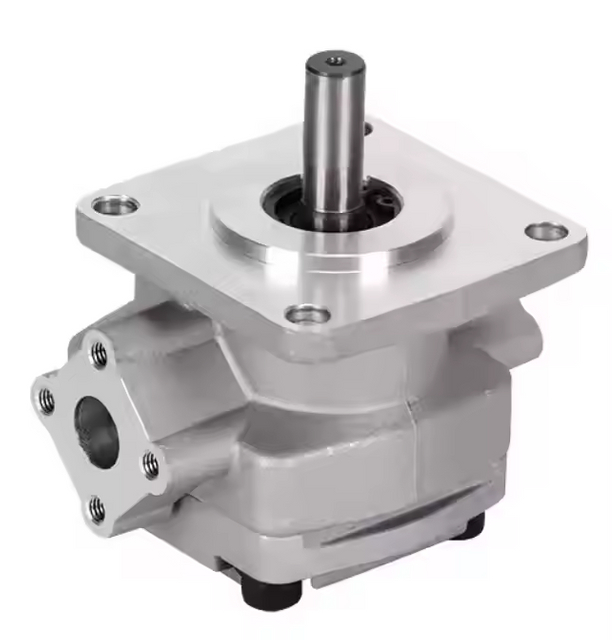
Spend five minutes talking to an old-school technician in any maintenance bay, and they will probably tell you that a hydraulic gear pump and a gear motor are identical twins. They look identical from the outside casting. Both use a pair of meshed gears inside. Both rely on tight internal tolerances to trap oil. But if you try to swap them on a heavy industrial machine, you are setting yourself up for an expensive mess of blown shaft seals, cracked housings, and immediate factory downtime.
The truth is hidden inside the micro-machined internal features. How fluid forces interact with the wear plates, bearings, and seals changes completely depending on whether the unit is building pressure or consuming it. Treating these two components as interchangeable assets means ignoring basic mechanical boundaries. Let us break down the exact engineering reasons why a pump cannot simply run backward as a motor without catastrophic field failures.
1. Core Energy Divergence & Casing Pressure Gradients
The whole design split starts with the direction of power conversion. A hydraulic gear pump is a flow generator. It hitches up to an external prime mover—like an electric motor or a diesel engine block. As the drive shaft spins the gears, a mechanical vacuum opens up at the intake port, drawing oil out of the reservoir. The teeth then sweep that oil around the casing wall and shove it out through the discharge port against system resistance. This builds a permanent, steep internal gradient: the suction side stays close to zero bar, while the outlet side screams up to full operating pressure.
A hydraulic gear motor works in reverse. It is a rotary actuator. Instead of creating flow, it eats pressure to spit out mechanical torque. High-pressure fluid hammers into the inlet port, forces the gear teeth to rotate, and drops its energy across the mesh before escaping through the low-pressure outlet. One builds flow; the other destroys fluid head to turn a shaft. Because of this flip, the internal hydraulic loading vectors on the gear journals and casing walls run in opposite directions, putting stress on completely different structural points of the metal body.
2. B2B Buyer Profiles and Hard System Limits
Procurement departments and machinery architects must design around hard system limits when drafting circuit blueprints. Gear pumps belong on the power input side. Think machine tool hydraulic power units, excavator pilot control loops, and agricultural implement lifts. Gear motors belong at the work end, driving heavy winch drums, high-velocity radiator cooling fans, and quarry conveyor belts.
Component Non-Applications
Standard Gear Pumps: Keep them away from any circuit where downstream directional valves can suddenly push high-pressure spikes back into the outlet port. Their asymmetric internal seals will fail under backpressure.
Standard Gear Motors: Never use them to lift oil from a deeply buried suction tank. They do not have the tight intake clearances or the suction characteristics required to pull a reliable prime from a negative fluid head.
3. Dynamic Shock Loads and Material Fatigue
Picture a heavy timber shredder or an aggregate grading conveyor processing raw material. If a massive log or an uncrushable stone suddenly jams the mechanical drive, the hydraulic actuator takes the full brunt of that kinetic stoppage. Fluid pressure within the gear cavities spikes within milliseconds. This is a severe hydraulic shockwave, often called a fluid hammer.
Standard gear pumps often use extruded aluminum alloys because they operate in steady-state systems. But high-pressure gear motors need far tougher armor to survive these violent pressure spikes without casing expansion. High-tier manufacturers like Blince cast their motor bodies from compacted graphite iron or high-tensile nodular ball iron with a tensile strength exceeding 500 MPa. If you put a light aluminum pump into a high-shock motor application, the housing will flex under pressure spikes. This forces the gear tips to score deep gouges into the internal casing walls, instantly ruining the volumetric efficiency.
4. Performance Parameters and Low-Speed Boundary Lubrication
Industrial gear units cover a wide operating envelope. Displacements typically range from a tiny 0.8 cc/rev up to more than 150 cc/rev. Gear pumps are built to run fast, usually between 600 and 4000 rpm. At these high velocities, the spinning shafts easily build a thick hydrodynamic oil film inside the sleeve bearings. This film keeps metal parts separated and locks in a high volumetric efficiency of 93% to 98%.
Gear motors have a much tougher job. They frequently have to start up under maximum load or crawl along at ultra-low speeds like 150 or 200 rpm. At those low speeds, the oil film thins out because the fluid shear rate drops too low. The motor enters a state of boundary lubrication. This causes high friction and erratic rotation, a problem known as the stick-slip effect. To fix this, genuine gear motors feature micro-profile tooth modifications ground onto the gear flanks. This design sacrifice lowers peak volumetric efficiency down to 88% or 94%, but it maximizes the starting torque needed to get a heavy load moving.
5. Internal Anatomy: Asymmetric vs. Symmetric Thrust Plates
If you take the rear cover off a high-end gear pump on your workbench, you will find floating thrust plates sealing the sides of the gears. To stop high-pressure oil from slipping across the flat gear faces, the design routes a tiny stream of pressurized oil behind these plates. This biases them tightly against the rotating gear assemblies.
In a single-direction gear pump, the rubber seals on the back of these thrust plates are completely asymmetric. They are shaped like an offset number 3 or 8 to apply clamping force only over the high-pressure discharge zone. The suction side stays unloaded to minimize mechanical drag. If you try to run this pump as a motor by feeding high pressure into the suction side, the fluid forces will oppose the asymmetric clamping zone. The plate will tilt under the uneven loading, causing immediate internal fluid bypass, heavy metal galling, and scoring on the gear faces.
A true bi-directional gear motor must handle high pressure on either port depending on which way the operator shifts the control valve. Its floating thrust plates feature perfectly symmetric, mirrored sealing zones on the back. This balancing act keeps the plates flat against the gears regardless of flow direction, providing stable sealing and protecting internal components from tilting forces.
6. Microfluidic Leakage and the Cubic Clearance Law
The physical clearance between the tips of the gear teeth and the housing bore is incredibly tight, usually held between 8 and 12 microns during production. The oil slipping through this tiny gap follows the physics of parallel-plate micro-clearance flow. You can model this internal volumetric slip with a straightforward mathematical relationship:
Q_loss ∝ (h⊃3; · ΔP) / (μ · L)
Where:
Q_loss represents the internal volumetric leakage flow rate.
h represents the physical height of the micro-clearance gap.
ΔP is the working differential pressure across the internal components.
μ is the dynamic viscosity of the hydraulic oil.
L is the sealing land contact length along the casing arc.
The real danger here is h⊃3; (the height cubed). If a cheap component suffers from poor manufacturing tolerances or worn bearings that widen that microfluidic gap by just a factor of two, your internal leakage does not just double. It multiplies by eight times (2⊃3;). This massive internal bypass takes pressure energy and turns it straight into heat. Your oil temperature will spike, viscosity will drop out of the safe zone, and the entire system will lose its ability to hold pressure.
7. QC Benchmarks and ISO 4406 Three-Body Abrasion
Building high-pressure gear equipment requires strict quality control and clean fluid. Because internal clearances are measured in single-digit microns, any shaft misalignment will destroy the unit. High-tier factories use automated coordinate measuring machines to audit bearing bore alignment to sub-micron accuracy before the parts ever reach the assembly bench.
Once your machinery is running in the field, the oil cleanliness level based on the ISO 4406 standard determines its lifespan. High-pressure gear pumps and motors need a clean system rating of at least ISO 4406 19/17/14. If the oil gets contaminated with hard particles like silica dust or metallic wear debris sized between 5 and 15 microns, it starts a destructive process called three-body abrasion. These tiny particles jam inside the clearance gap (h), acting like microscopic cutting tools that slice tracks into the soft housing walls. This tears down the internal sealing boundaries, drives up the leakage rate, and causes rapid failure.
8. Digital Manufacturing and Cross-Border Logistics Protection
For modern machinery OEMs, reliable supply chains matter just as much as raw metal specs. High-performance gear pump production relies on six-axis CNC machining centers and automated grinding systems that eliminate human error across large production runs. If a project requires a non-standard shaft extension, unique SAE or European port sizes, or custom mounting interfaces, flexible manufacturing setups let the factory adjust designs and ship custom batches within 4 to 6 weeks.
Shipping precision components across ocean routes exposes them to salt air and high humidity. Long-term corrosion protection must be built into the packaging line. Completed pumps and motors are flushed internally with specialized testing oil, sprayed externally with a high-performance rust preventative, vacuum-sealed in heavy moisture-barrier poly film, and packed inside reinforced, ISPM-15 compliant wooden boxes. This keeps them clean and rust-free during shipping so they are ready for installation upon arrival.
9. The Definitive Divide: External Case Drain Ports
Here is the single biggest structural difference in fluid power: the external case drain port. This single feature explains why standard pumps cannot survive as motors.
A standard single-direction gear pump handles its internal leakage—the tiny stream of oil that slips past the bearings and gears—through an internal channel. This channel routes the bypass oil straight back into the low-pressure suction side of the casing. Because the suction line leads directly to the oil reservoir, the fluid pressure acting on the drive shaft lip seal stays incredibly low, usually under 1.5 bar. This setup works perfectly with a standard nitrile rubber lip seal pressed into the front nose flange.
If you plumb high-pressure oil into that pump's discharge port to run it as a motor, the original inlet port becomes your return line. In real-world industrial systems, return lines are rarely at zero pressure. They experience backpressure from long hose runs, return filters, or downstream valves. This backpressure pushes right into the internal leakage channel and hammers the backside of the shaft seal. Standard lip seals are only rated for about 3 bar. Exposure to higher backpressure will instantly flip the seal lip inside out or blow it completely out of its seat, causing massive oil loss and shutting down the machine.
A dedicated gear motor avoids this failure point with an external case drain port machined into the rear cover plate or bearing housing. This layout isolates the internal leakage chamber completely from the working ports. The bypass oil vents out through a separate, unpressurized third line that connects straight back to the top of the reservoir. This keeping the shaft seal chamber at atmospheric pressure, protecting the seal even if backpressure spikes on the main return line.
10. The Retrofit Pitfall: Evaluating Motor-to-Pump Field Conversions
Technicians on industrial forums often debate whether a spare gear motor can replace a failed gear pump in an emergency. While a bi-directional gear motor will rotate and move fluid when spun mechanically, doing so introduces significant operational penalties that make it a poor long-term fix.
Because the motor's internal thrust plates are perfectly symmetric to allow two-way rotation, they cannot match the sealing efficiency of an asymmetric pump plate. The internal fluid slip will be much higher, causing the unit to run hot and struggle to build maximum system pressure. Furthermore, a dedicated pump has an inlet port that is physically larger than its outlet to keep fluid velocity low and prevent vacuum drops. A motor has identical port sizes. Forcing a motor to act as a pump often causes the fluid velocity at the intake to exceed safe limits, triggering severe cavitation. This creates intense localized implosions that pit the gear teeth and destroy the casing within days.
11. OEM/ODM Custom Splines, Flanges, and Compound Seals
Industrial machinery setups often require components customized for tight physical spaces or harsh environments. Standard off-the-shelf catalog models rarely fit these specialized integration needs:
Shaft Adaptations: Options range from standard SAE straight-keyed shafts for simple pulley belt configurations to high-torque involute splined shafts designed for heavy-duty mobile machinery power take-offs.
Mounting Interface Configurations: Standard SAE A, B, and C two-bolt or four-bolt mounting patterns can be integrated alongside European standard rectangular four-bolt flanges to allow drop-in replacement across various equipment lines.
Advanced Elastomer Compounds: If a machine operates in high-temperature environments above 100°C or utilizes synthetic, fire-resistant ester-based hydraulic fluids, standard nitrile seals will rapidly harden and crack. Upgrading to Viton or fluorocarbon-based compound seal kits ensures chemical compatibility and long-term sealing performance.
12. Shop Floor Maintenance Protocols and Predictive Diagnostics
Achieving the full 20,000-hour design life of high-pressure gear machinery requires strict adherence to field maintenance best practices:
Keep Case Drain Lines Unrestricted: Never install an inline filter, ball valve, or check valve on a gear motor's external case drain line. The line must run completely open and discharge below the oil level at the top of the reservoir. Any restriction will elevate seal chamber pressure and cause a shaft seal failure.
Monitor Casing Temperature Differentials: Install permanent diagnostic test points on the inlet and outlet lines. Regularly scan the component housing with an infrared thermal imager. A sharp increase in casing temperature relative to the return line oil indicates that internal clearances have widened, signaling that the unit should be scheduled for rebuilding before a catastrophic failure occurs.
Perform Quarterly Spectrometric Oil Analysis: Regularly sample the system fluid to track wear trends. A sudden increase in copper, tin, or iron parts per million provides early warning that the bronze thrust plates or alloy steel gears are experiencing abnormal wear, allowing you to catch internal damage early.
13. Engineered Reliability for Global Supply Chains
Selecting the correct fluid power components requires balancing mechanical capability, material quality, and supply chain predictability. Misidentifying the subtle structural elements that separate pumps from motors leads to early component failure and expensive field troubleshooting. Blince engineering team specializes in evaluating system parameters, analyzing duty cycles, and delivering precision-manufactured gear pumps and motors tailored for demanding industrial environments. Contact our application specialists today to request comprehensive CAD prints, secure technical evaluations, and optimize your machinery supply chain.
Table 2: Gear Motor vs. Gear Pump Deep Structural Comparison
Feature / Structural Dimension
Hydraulic Gear Pump
Hydraulic Gear Motor
Energy Conversion Role
Converts mechanical input torque to fluid flow
Converts fluid pressure to mechanical torque output
Internal Plate Symmetry
Asymmetric offset design, optimized for one-way high pressure
Fully symmetric mirrored design to balance dual-rotation load
Case Drain Configuration
Internal passage channels leakage to low-pressure suction side
Mandatory independent external case drain line to reservoir
Shaft Seal Pressure Tolerance
Very Low (Typically < 1.5 bar; prone to blowing out)
Protected and isolated via the open external drain path
Rotation Optimization
Unidirectional design (Strictly designated CW or CCW)
Bi-directional design (Reversible flow paths)
Oil Port Sizing Dimensions
Inlet port is significantly larger to minimize cavitation risks
Inlet and outlet ports are identical in diameter size
Long-Term Cost Level
Base standard volume pricing structure
Slightly higher due to dual-symmetric machining tolerances
FAQs
Q1: Why is the purchase price of a gear motor typically higher than a gear pump of identical displacement?
The price difference reflects the more complex internal architecture required by a motor. Gear motors must feature complete internal symmetry, complex mirrored pressure-loading zones behind the thrust plates, bi-directional shaft seals, and an independently machined external case drain channel to ensure structural stability under reversing loads. These requirements increase both machining time and raw material costs during production.
Q2: What is your standard factory lead time for a production batch of customized OEM gear pumps?
For custom shaft configurations, specialized port configurations, or modified mounting flanges, our typical production lead time ranges from 4 to 6 weeks. This timeline includes precision machining, heat treatment, and final quality control testing. We also maintain a substantial inventory of standard SAE configurations to support urgent replacement needs.
Q3: Can a hydraulic gear motor safely run in a system if the external case drain port is plugged?
No. If the external case drain port is blocked, internal leakage fluid will rapidly accumulate within the bearing and shaft seal chamber. Because hydraulic oil is virtually incompressible, the pressure inside this isolated chamber will spike to match the main inlet pressure within moments. This extreme pressure will instantly blow the shaft seal out of its seat, leading to severe oil loss and system failure.
Q4: How does your factory safeguard proprietary designs and intellectual property for custom OEM machinery projects?
We enforce strict intellectual property protection protocols. Before exchanging any system schematics, CAD designs, or operational parameters, we execute a legally binding Non-Disclosure Agreement (NDA). All custom tooling, automated machining programs, and unique component specifications are securely segregated within our ERP system, ensuring they are never shared with third parties.
Q5: What happens to a standard unidirectional gear pump if it is driven in the wrong direction?
Operating a unidirectional pump backward swaps the internal high-pressure and low-pressure zones. The high-pressure discharge oil is routed into the unsealed intake side of the housing. This forces high pressure directly against the low-pressure shaft lip seal, causing it to blow out instantly. It also leaves the internal bearings without proper lubrication, leading to rapid mechanical galling and failure.
Q6: Are your gear components compatible with high-temperature environments or specialized fire-resistant fluids?
Yes. For systems operating in high-temperature environments or using synthetic, fire-resistant ester-based hydraulic fluids, we replace all standard nitrile seals with high-performance Viton or fluorocarbon compounds. We also adjust internal tolerances to accommodate thermal expansion, preventing internal component binding under high heat.
Q7: What is the minimum stable operating speed for your gear motors under full system load?
Our standard industrial gear motors can maintain smooth, continuous rotation down to 200 rpm under full load. Operating below this threshold reduces the relative motion between components, preventing the formation of a proper hydrodynamic oil film and increasing wear. If your application requires continuous operation below 200 rpm, we recommend considering an orbital motor solution.
Q8: Do you offer reverse-engineering and design adaptation services to replace obsolete legacy pumps from other brands?
Yes, our application engineering team specializes in legacy component replacement. By analyzing your existing unit's mounting configuration, shaft dimensions, port threads, and performance curves, we can design and manufacture a direct drop-in replacement that integrates into your current setup without requiring modifications to your existing plumbing.
Q9: Does high backpressure on a gear motor's outlet port pose a risk to its shaft seal?
High outlet backpressure will not harm the shaft seal, provided the external case drain line is properly connected and runs completely unrestricted back to the reservoir. Because the seal chamber vents independently through the case drain, it remains isolated from pressures on the main return line, keeping the shaft seal safe.
Q10: Exactly how does fluid contamination matching or exceeding ISO 4406 limits destroy internal gear housings?
When hydraulic fluid contains solid contaminant particles larger than the component's internal clearances (typically 8-12 microns), those particles enter the clearance spaces between the gear tips and the housing track. As the gears rotate, these hard particles act as micro-cutting abrasive agents that score deep furrows into the metal surfaces. This increases the internal clearance, which exponentially drives up internal leakage and causes a severe drop in system volumetric efficiency.
This article is a general engineering guide. Final component selection should be based on machine drawings, measured hydraulic data, working conditions, safety requirements, and confirmation from a qualified hydraulic engineer or supplier.
Blince Hydraulic Team
Blince Hydraulic is an industry-leading company dedicated to precision-engineered fluid power manufacturing and custom hydraulic solutions. Backed by decades of deep field expertise in industrial machinery and thousands of successful global deployments, our engineering team focuses entirely on high-performance hydraulic component manufacturing, including specialized orbital motors, high-pressure travel drives motor, and robust directional control valves. Our production infrastructure utilizes state-of-the-art multi-axis CNC machining systems and is fully ISO 9001 certified to guarantee repeatable volumetric accuracy across every single manufacturing run.
We deliver fast, highly dependable, and cost-efficient hydraulic solutions to heavy industry distributors, machinery OEMs, and maintenance crews across more than 150 countries. Whether your active project calls for a small-volume batch of customized shaft profiles or a large-scale production run of severe-duty cast iron gear pump, we configure our flexible production schedules to meet your target lead times with total pricing predictability. Partnering with Blince means securing maximum system efficiency, elite material quality, and uncompromised fluid power professionalism.
To learn more about our complete product lineup, visit our official website: www.blince.com.