Directional control valves route hydraulic fluid via an internal spool. When the spool is centered (neutral), different center positions (O, H, Y, M) determine which ports (pressure, tank, actuator ports) are connected or blocked. The four common center types are:
O-Type (Closed Center): All ports (P, A, B, T) are blocked in neutral, locking the cylinder in place.
H-Type (Open/Float Center): P port connects to T, and A/B interconnect, allowing continuous pump flow to tank and actuator ports to float together.
M-Type (Tandem/Unload Center): P→T open (pump unload) while A and B are blocked, so the pump is unloaded but the actuator remains locked.
Y-Type (Float/Motor-Friendly Center): P port closed but A/B connected to T, letting actuators drift to tank without back-pressure.
Each center configuration balances load-holding vs energy use. For example, a closed/O-center holds heavy loads securely (at the cost of pump pressure), while an open/H-center dumps flow to save energy. These distinctions are crucial when specifying hydraulic directional control valves and valve blocks for machinery. In Belt & Road markets (e.g. Latin America, Russia), engineers commonly encounter these terms in solenoid valve and manifold specifications for tractors, harvesters, and mining rigs.
O-Type (Closed Center)
All ports blocked: In the neutral position, pump (P), tank (T), and actuator ports (A/B) are isolated. The hydraulic actuator is locked in place (no flow path to relieve pressure).
Load-holding: Because oil can’t bleed off, the cylinder holds its load (ideal for clamp presses, heavy lifts, or any precise position-hold application).
Energy Drawback: The pump continues to build pressure against the closed spool, generating heat. Closed-center valves typically require relief or variable pumps to manage this pressure.
H-Type (Open/Float Center)
P→T Unloaded: In neutral, the pump port is connected to tank, so the pump runs unloaded, reducing energy consumption.
A↔B Float: Actuator ports A and B interconnect, so cylinders or motors are free to float. If an external force acts on a cylinder, fluid moves freely between A and B.
Energy Saver, No Holding: The pump flow bypasses the circuit, avoiding heat buildup. However, with no hydraulic lock, actuators have no load-holding; implements will drift or float unless blocked by a check or counterbalance valve.
Use Case: Common in multi-valve circuits and mobile machinery where multiple actuators share a single pump (e.g. shared circuits on harvesters or forklifts). It also allows manual override of actuators (e.g. free wheeling a motor).
M-Type (Tandem Center – Unload with Actuator Lock)
Pump Unload + Lock: The spool shorts pump flow P→T (like H-type) while blocking A and B. This “tandem” center locks the actuator (no flow out of A/B) even as the pump is unloaded.
Energy Efficiency + Safety: This hybrid center lets the pump run against low load (saving energy) while still holding the load firmly. It’s ideal for fixed-displacement pumps that must unload.
Use Case: Heavy lifts or jacks (e.g. mining or construction equipment) that need to hold a load when neutral. For instance, a mining winch or lift valve might use M-center so the drum holds position but the pump is relieved.
Y-Type (Float/Motor-Friendly Center)
Actuators to Tank: In neutral, P is closed while A and B connect to tank. The cylinder or motor is effectively floated (both ends open to tank).
Soft Lowering: Because there’s no pressure in A/B (no back-pressure), a heavy load can descend or a motor will coast down gently under gravity. This prevents shock from trapped pressure.
Pump Pressure Maintained: The pump sees pressure but no flow (since P is blocked), so in practice a pressure relief or unloading stage is still needed. Y-type drains actuator chambers to the reservoir.
Use Case: Commonly used for controlled lowering. For example, a front loader’s float function (Y-center) allows the bucket to follow ground contours. Many tractor implements (e.g. forklift tines, planters) use Y-center valves to free-fall after raising.
Integrated Valve Blocks & Applications
Modern hydraulic valve blocks (manifolds) often house multiple spool sections with different center types in one body
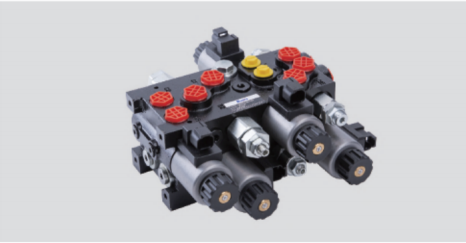
. For example, a tractor’s main valve block might have: an O-center section for the steering cylinder (to lock the wheel), an M-center section for a heavy lift (to hold while unloading the pump), and a Y-center section for implement float (to lower attachments). The embedded block (pictured) shows a multi-valve assembly (Blince HSG/K series) where each section’s center can be specified individually.
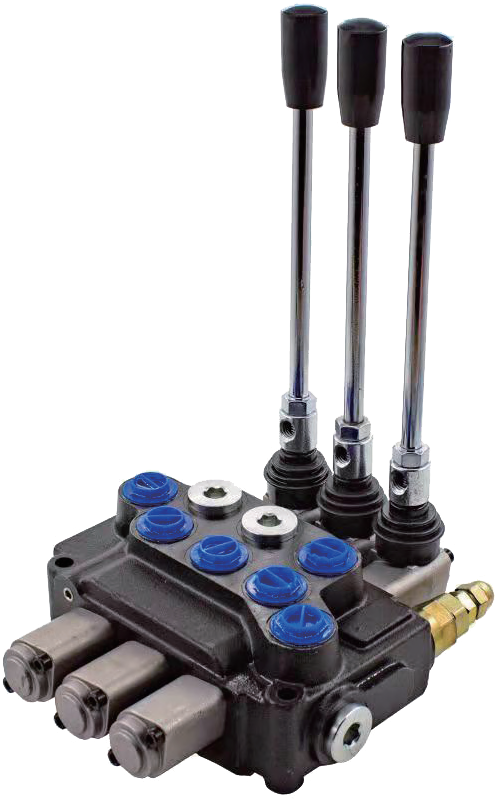
Product Examples: Blince’s catalog includes manual/solenoid 4-way valves designed for agricultural and heavy equipment. For instance, a 3-position 4-way valve for tractors, and joystick-operated monoblock valves for farm implements, each allowing choice of center function. Such valve modules meet diverse needs across agricultural machinery and mining equipment, helping procurement professionals tailor systems (e.g. using solenoid valves for agriculture machinery that incorporate the needed center spool for each function).
Frequently Asked Questions
Q: What is the difference between closed-center (O-type) and open-center (H-type) valves? A: A closed-center valve blocks all ports in neutral, locking the actuator and trapping pressure (good for holding position). An open-center valve connects the pump to tank and links work ports (P→T, A↔B) in neutral, so the pump unloads and the actuator floats. Closed-center is chosen when load holding is needed, while open-center saves energy and prevents pressure buildup at idle.
Q: Why use a float (Y-type) center in agricultural machinery? A: Y-center (motor-friendly) valves have P closed and A/B open to tank. This lets implements free-fall under gravity with minimal pressure. In practice, farm equipment (e.g. loaders, planters) uses Y-center spools to lower attachments smoothly. It prevents actuator “kick” from trapped oil and helps the hydraulic pump respond quickly when the lever is moved again.
Q: What does “tandem center” (M-type) mean and when is it used? A: Tandem (M-type) center means the pump port is dumped to tank while the actuator ports are blocked. In other words, the valve unloads the pump but still locks the cylinder. This is useful for heavy-load valves: the pump is free of load (saving power) but the cylinder remains held (e.g. preventing a digger arm from drifting down).
Q: Which center type is best for energy savings on a multi-actuator system? A: For maximum pump unloading, open-center (H-type) or tandem (M-type) are used. H-center unloads the pump and lets actuators float, ideal for multi-circuit systems. M-center also unloads the pump but keeps actuators locked. Choosing between them depends on whether you need load holding (M-type) or don’t (H-type). In any case, these configurations reduce energy waste when the machine is not actively moving loads.
Q: How do I specify the right center type when ordering hydraulic valves? A: Look at your application needs: if you need actuators to hold, use closed-center (O) or tandem (M); if you need float-down capability, use Y-center. In Belt & Road markets (Latin America, Russia, etc.), catalogs often list valves with “O”, “H”, “Y”, or “M” center options. Always match the valve center to your circuit: e.g. valve blocks for tractors often combine an O-center for steering with a Y-center for loader float.