Hydraulic motors are the workhorses of modern fluid power systems. Wherever rotary mechanical energy is needed in environments where electric drives are impractical — inside an excavator arm, at the core of an offshore anchor winch, or deep in a mining conveyor drive — a hydraulic motor is converting pressurized fluid into torque and shaft rotation. This guide covers the core principles of hydraulic motor technology, the main motor families available today, how to match a motor to a real application, and what engineers across different global markets should pay attention to when sourcing and specifying these components.
How a Hydraulic Motor Works
At its most fundamental level, a hydraulic motor is a rotary actuator. A hydraulic pump generates pressurized fluid flow; the motor consumes that flow and delivers torque at an output shaft. The governing relationships are straightforward:
Torque is proportional to displacement (cm³/rev) and differential pressure (bar or MPa)
Speed (rpm) is proportional to flow rate (L/min) divided by displacement
Power equals torque multiplied by angular velocity — and is ultimately limited by system pressure and flow capacity
Volumetric efficiency describes how much of the supplied fluid is productively converted to shaft rotation versus lost to internal leakage. Mechanical efficiency describes friction losses. The product of both gives overall efficiency — a figure that ranges from roughly 75% for simple gear motors up to 92%+ for high-quality piston motors at their design point.
Understanding these basics allows engineers to define the motor size and type needed before opening any catalog.
The Main Hydraulic Motor Families
1. Orbital (Geroler / Gerotor) Motors
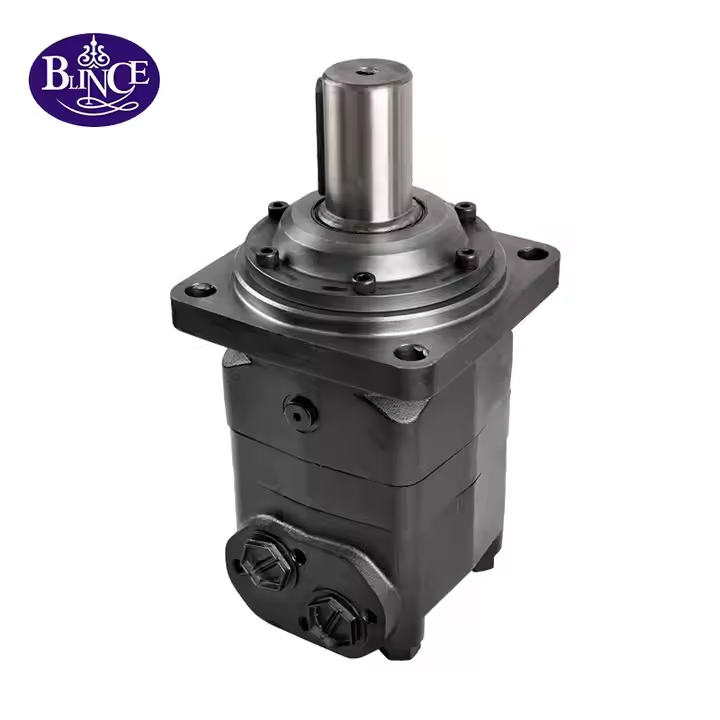
Orbital motors — sometimes called orbit motors — are compact, low-cost, low-speed high-torque (LSHT) units that use an inner rotor with one fewer tooth than the outer ring gear. Pressurized fluid entering between the lobes forces the rotor to orbit eccentrically, producing shaft rotation via a cardan shaft or splined coupling. The simplicity of the design gives orbital motors excellent reliability relative to their cost.
Disc-ported orbital motors use a flat valve plate to time inlet and outlet ports. The OMT Series orbital motor, for example, uses an advanced Geroler gear set with disc distribution flow and high-pressure capability, allowing individual configuration for a wide range of multifunctional operating requirements. A higher-torque option in this family — the TMT V Series high-torque orbital motor — provides a displacement of 400 cm³/rev with a 17-tooth splined shaft, targeting applications such as crane slewing, log handling, and heavy conveyor systems that demand powerful low-speed output.
Shaft-ported orbital motors route flow through the shaft itself rather than a disc, enabling different installation orientations. The OMRS Series shaft-ported orbital motor is equivalent to the Eaton Char-Lynn S 103 series in geometry and performance, incorporating a Geroler gear set that automatically compensates for internal wear at high pressures, maintaining smooth and efficient operation over an extended service life.
For construction equipment, the OMER Series orbit motor is particularly well-established in excavator and loader attachment circuits, with a continuous working pressure range of 10.5–20.5 MPa and rated pressure reaching 27.6 MPa — a robust pressure envelope for intermittent peak demands in cycle-intensive jobs.
Another notable orbital motor option is the BMK2 orbital motor, which is equivalent to the Eaton Char-Lynn 2000 series (104-xxxx-xxx), using a Geroler gear set with disc distribution flow and high-pressure design. It can be configured for individual operating variants across multifunctional applications, making it a versatile cross-reference alternative for systems originally specified around the Char-Lynn 2000 series.
Best suited for: agriculture, construction attachments, material handling, conveyor drives, light winching, and any application requiring compact low-speed torque at reasonable cost.
2. Radial Piston Motors
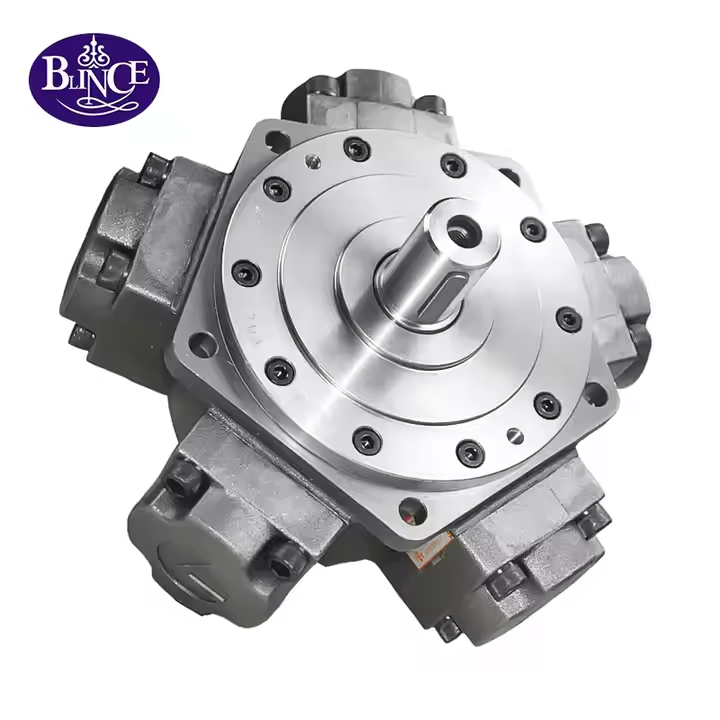
Radial piston motors place multiple pistons radially around a central crankshaft or camring. Pressurized fluid pushes each piston outward in sequence, driving the crankshaft through a continuous torque cycle. Because several pistons fire in staggered sequence, the torque output is exceptionally smooth even at very low shaft speeds — some models achieve stable rotation below 10 rpm.
This architecture delivers the highest torque density of any hydraulic motor type and can withstand pressures up to 350 bar or more in heavy-duty configurations. The tradeoff is higher mechanical complexity and cost compared to orbital or gear motors.
LD Series — The Foundational Radial Piston Family
The LD Series radial piston motor is the entry point to this performance category: manufactured from high-quality cast iron, certified to ISO 9001 and CE standards, and designed for robust continuous-duty operation in demanding environments. Within the LD Series, several displacement and speed variants address specific load profiles:
The LD6 radial piston motor is rated to 315 bar and handles the cyclic high-load demands of log grapples, excavators, and loader attachments. Its multi-piston design maintains smooth torque delivery throughout the load cycle.
The LD2 radial piston motor offers a broad speed range in a compact package, performing consistently in excavator swing drives and loader wheel motors where space is constrained.
The LD3 radial piston motor operates at 16–25 MPa continuously and peaks at 30–35 MPa, with a rated speed range of 300–3,500 rpm. Select models maintain stable rotation below 30 rpm — well within the requirement for direct-drive winch and slewing applications.
The LD8 radial piston motor broadens the speed envelope to 200–3,000 rpm, with certain configurations achieving stable speeds under 20 rpm. It carries FSC, CE, ISO 9001:2015, and SGS certifications — a compliance profile often required for international project procurement.
The LD16 radial piston motor shares the same cast iron construction and multi-piston architecture as the rest of the family, combining high torque output with a broad certification set (FSC, CE, ISO 9001:2015, SGS) for use in excavators, loaders, and heavy industrial machinery.
Beyond the LD family, several other radial piston variants address specialized duty cycles:
The IAM radial piston motor is engineered for slewing, winching, mining, and marine direct-drive systems where reliability, smooth motion, and long service intervals are critical. Its design prioritizes zero-speed holding capability and resistance to shock loading.
The BMK6 radial piston motor uses a multi-plunger layout inside a cast iron housing, providing strong, smooth power output in heavy industrial environments with a one-year warranty standard.
The ZM radial piston motor is a compact radial piston option available directly from the manufacturer for heavy-duty applications requiring high torque in a more condensed form factor.
The NHM radial piston motor is characterized by high torque output and compact design, making it suitable for demanding hydraulic applications where installation space is at a premium alongside serious load requirements.
The HMC radial piston motor rounds out this category, offering another compact high-torque option for demanding drive applications.
Best suited for: winches, augers, mixers, crane slewing, mining conveyors, forestry machinery, marine anchor systems, and any direct-drive load requiring very low minimum speed and very high torque.
3. Gear Motors
Gear motors are the simplest and most cost-effective hydraulic motor design. External gear motors use two meshing spur gears: pressurized fluid enters on the inlet side, fills the spaces between gear teeth, travels around the housing periphery, and exits at the outlet — driving shaft rotation in the process. Internal gear motors use a gerotor set for a more compact layout.
The main advantages of gear motors are low cost, high operating speeds, compact size, and simple serviceability. They are not ideal for very low speed or very high torque applications, but they are hard to beat for moderate-duty drives at medium-to-high speeds.
The GM5 Series gear hydraulic motor is a high-performance gear motor engineered for demanding power transmission, delivering efficient torque in hydraulic systems that require reliable medium-duty operation. The External Group Series gear motor extends the gear motor range to mobile and industrial hydraulic applications requiring high speed, stable performance, and flexible mounting options — all at a competitive cost point.
For applications where weight and response time are critical, the CMF Series compact gear motor is a lightweight, high-speed solution designed for rapid response and robust performance in mobile equipment where every kilogram of drivetrain weight matters.
Best suited for: fan drives, pump drives, light conveyor drives, material handling, agricultural sprayer systems, and any application where moderate speed and torque at low cost is the priority.
4.Travel Motors
Travel motors are integrated hydraulic drive units — typically combining a radial or axial piston motor with a planetary gear reduction stage and a spring-applied, hydraulic-released parking brake into a single sealed assembly. This integration makes them the standard solution for propelling tracked excavators, compact track loaders, mini-excavators, and skid-steer machines.
The MS Series travel motor exemplifies this category: cast iron construction, integrated braking system, and certified to FSC, CE, ISO 9001:2015, and SGS standards. The all-in-one design simplifies OEM machinery integration and reduces the total component count in a propulsion system.
Best suited for: tracked construction equipment, compact machinery, mobile crane undercarriages, and any mobile platform requiring self-contained propulsion with parking brake capability.
5.Slew Motors
Hydraulic slew motors — also called swing motors or rotation motors — drive the 360-degree upperstructure rotation of excavators, mobile cranes, and knuckle-boom equipment. They must deliver smooth, controllable torque against a rotating mass while handling high radial and axial loads at the output bearing.
The OMK2 Series slew motor uses a column-mounted stator and rotor configuration that ensures reliable performance under the cyclic loading and inertial shock typical of excavator and crane swing cycles. Its cast iron construction provides the structural rigidity necessary to maintain bearing alignment over extended service life.
Best suited for: excavator upperstructures, mobile cranes, harbor cranes, drilling rigs, and any machinery requiring controlled 360-degree rotation under load.
How to Select the Right Hydraulic Motor
Matching a hydraulic motor to an application requires working through a defined set of parameters. Skipping any of these typically leads to undersizing (overheating, shortened life), oversizing (cost waste, poor speed control), or a mismatch between motor geometry and system pressure/flow limits.
Step 1 — Define the load
Determine the required continuous torque and peak torque at the output shaft. For rotating loads: T = F × r (force times moment arm). For lifting/winching: T = (Force × drum radius) ÷ mechanical efficiency.
Step 2 — Define the speed requirement
What is the minimum stable speed the application needs? What is the maximum speed? A wide speed range — especially a very low minimum speed — points toward radial piston or orbital motors rather than gear motors.
Step 3 — Determine system pressure
Your hydraulic system's rated operating pressure and relief valve setting define the maximum pressure differential available to the motor. Higher available pressure allows a smaller displacement motor to deliver the same torque.
Step 4 — Calculate displacement
Theoretical displacement (cm³/rev) = (2π × Torque in Nm) ÷ (Pressure differential in bar × 0.1 × mechanical efficiency)
Then calculate required flow: Q (L/min) = (Displacement × Speed in rpm) ÷ (1000 × volumetric efficiency)
Step 5 — Match motor type to application profile
Requirement
Recommended Motor Type
Very low minimum speed (< 30 rpm), high torque
Radial piston motor
Low-to-medium speed, high torque, compact size
Orbital (geroler) motor
Medium-to-high speed, moderate torque, low cost
Gear motor
Self-contained track/wheel propulsion
Travel motor (integrated)
360° rotary swing drive
Slew motor
Variable speed/torque, high efficiency
Axial piston motor
Step 6 — Check shaft, mounting, and fluid compatibility
Confirm shaft type (keyed, splined, tapered), flange standard (SAE, ISO, metric), port sizes, case drain requirements, and fluid type compatibility (mineral oil, biodegradable, water-glycol).
Regional Sourcing and Application Considerations
Hydraulic motor requirements differ by geography, driven by dominant industries, local standards, and environmental conditions.
North America
The North American market is heavily driven by construction equipment, agricultural combines, forestry machinery, and oilfield services. SAE flange standards and inch-series spline shafts are predominant. CE marking is increasingly expected for cross-border sales into Canada, while UL or CSA considerations apply to some industrial installations. Radial piston and orbital motors in the high-torque range dominate forestry and oilfield applications.
Europe
European specifications lean toward EN/ISO standards, and energy efficiency compliance under EU Ecodesign directives pushes engineers toward higher-efficiency piston motors for variable-load drives. Marine and offshore applications — particularly in the North Sea and Baltic — require high corrosion resistance, broad temperature tolerance, and often DNV or other classification society approval. CE marking is mandatory for all new machinery placed on the EU market.
Southeast Asia and Australia
Mining, palm oil processing, construction, and agricultural mechanization dominate demand across this region. High ambient temperatures mean fluid viscosity management is critical — motors must tolerate thinner oil at operating temperatures without excessive internal leakage. Compact, serviceability-friendly designs are valued in remote operation sites. ISO 9001 and CE certification are commonly specified in project procurement requirements.
Middle East and Africa
Oil and gas infrastructure, desalination plant construction, and large civil engineering projects drive hydraulic motor procurement. Corrosion-resistant materials, IP-rated connectors, and wide operating temperature ranges (from desert heat to air-conditioned machinery rooms) are important. Long-term spare parts availability and international certification (ISO, CE, SGS) are key decision factors for major contractors and EPC firms.
China and East Asia
China's massive OEM machinery export sector — excavators, agricultural equipment, industrial machinery — creates strong demand for cost-competitive motors with international certifications (CE, ISO 9001, SGS) that satisfy end-customer import requirements in Europe and North America. Consistent batch-to-batch quality, short lead times, and responsive technical support are the top sourcing priorities for OEM procurement teams.
Latin America
Infrastructure development, sugarcane and soybean agriculture, and growing mining activity underpin hydraulic motor demand across Brazil, Chile, and neighboring countries. Bilingual (Portuguese/Spanish) technical documentation is increasingly valued. Adaptability to mixed-quality hydraulic fluid and robustness to dusty, high-humidity environments are practical requirements.
Hydraulic Motor Maintenance: Extending Service Life
Even the most robustly built hydraulic motor will fail prematurely if operated outside its design parameters or if basic maintenance practices are neglected. The following guidelines apply across all motor types:
1. Maintain fluid cleanliness. Contamination — both particulate and water ingress — is the leading cause of premature hydraulic motor failure. Follow the manufacturer's recommended ISO 4406 cleanliness class (typically 16/14/11 or better) and change filter elements on schedule, not just on visual inspection.
2. Respect rated pressure limits. Brief pressure spikes above the rated maximum are manageable by most motors; sustained overpressure accelerates seal wear, bearing fatigue, and internal leakage. Size relief valves correctly and verify system peak pressures with a calibrated gauge before commissioning.
3. Manage case drain back-pressure. All piston and orbital motors have a case drain port. Excessive back-pressure — typically above 2–3 bar — can force fluid past the output shaft seal, causing external leakage. Run drain lines directly to the tank, unrestricted.
4. Monitor and control fluid temperature. Hydraulic oil degrades rapidly above 80°C, and viscosity drops to the point where motor internal clearances are no longer adequately lubricated. Install a heat exchanger or oil cooler if continuous operating temperature exceeds 70°C.
5. Allow cold-weather warm-up. In sub-zero environments, allow the hydraulic system to warm up at low load for 5–10 minutes before applying full working pressure. Cold, viscous oil starves the motor of adequate flow and can cause cavitation damage.
6. Inspect shaft seals at regular intervals. A trace of oil weeping from the output shaft seal indicates early seal wear. Addressing seal replacement at this stage is far less costly than allowing internal contamination that follows a catastrophic seal failure.
7. Record and trend case drain flow. Periodic measurement of case drain flow at a fixed operating condition is one of the most effective ways to detect gradual internal wear before it becomes catastrophic bypass leakage. A rising trend signals that motor refurbishment or replacement is approaching.
FAQ
Q1: What is the difference between a hydraulic pump and a hydraulic motor?
A hydraulic pump converts mechanical shaft energy (from an engine or electric motor) into pressurized fluid flow. A hydraulic motor does the reverse: it consumes pressurized fluid and produces shaft rotation. While many designs — particularly gear and piston types — are geometrically similar and can theoretically operate in either mode, the internal porting, bearing arrangement, and seal design of each unit are optimized for its specific function. Using a pump as a motor (or vice versa) is possible in some cases but requires careful engineering review.
Q2: What does "low-speed high-torque" (LSHT) mean, and which motor types qualify?
LSHT motors are designed to produce high continuous torque at shaft speeds typically below 500 rpm — often as low as 5–50 rpm — without requiring gearbox reduction. This allows direct coupling to slow-moving loads (augers, winch drums, rock crushers, mixers) and eliminates the cost, weight, and maintenance of a gearbox. Radial piston motors and orbital (geroler) motors are the two LSHT families; radial piston motors generally achieve lower minimum stable speeds and higher torque at equivalent pressure.
Q3: How do I calculate the hydraulic motor displacement I need?
Start with the required output torque and available system pressure:
Q4: Can I use an orbital motor for a high-speed application?
Orbital motors are designed for low-to-medium speed operation — typically up to 500–800 rpm depending on displacement. At higher speeds, centrifugal forces on the orbiting rotor increase internal leakage and heat generation, reducing efficiency and accelerating wear. For speeds above 800–1,000 rpm, gear motors or axial piston motors are more appropriate choices.
Q5: What certifications should I look for when sourcing hydraulic motors internationally?
The most widely accepted certifications are:
ISO 9001:2015 — quality management system (process-level assurance)
CE marking — mandatory for sale into the European Economic Area; confirms conformance to EU machinery and pressure equipment directives
SGS — third-party inspection and testing, widely recognized in Asia, Middle East, and Africa procurement
FSC — relevant for applications in forestry equipment
For marine and offshore applications, look for classification society approval (DNV GL, Lloyd's Register, ABS). Always request documentation rather than relying on claims alone.
Q6: What is the difference between a radial piston motor and an orbital motor?
Both are LSHT motor types, but their internal mechanisms differ substantially. An orbital motor uses a Geroler or gerotor gear set with typically 6–12 lobes and a relatively simple cardan shaft coupling — resulting in low cost, compact dimensions, and good torque for moderate-duty cycles. A radial piston motor uses 5–8 or more individual pistons bearing against a camring or crankshaft, delivering significantly higher torque at lower minimum stable speeds (sometimes below 10 rpm), greater peak pressure capability (up to 350 bar+), and longer service life in continuous heavy-duty use. Orbital motors are preferred where cost and size dominate; radial piston motors are selected when torque density, minimum speed, or pressure rating is the limiting factor.
Q7: How do I identify whether a hydraulic motor has failed or whether the issue is elsewhere in the system?
Before condemning a hydraulic motor, verify:
That system pressure at the motor inlet is reaching the specified value under load
That return line back-pressure is within specification
That case drain back-pressure is below 2–3 bar
That fluid temperature is within the normal operating range
That fluid cleanliness has not deteriorated (take a sample and send for lab analysis)
If all of these check out, measure case drain flow: significantly elevated drain flow (compared to the manufacturer's specification at the test pressure) confirms internal leakage — the primary indicator of motor wear requiring refurbishment or replacement.
Q8: What hydraulic fluid is compatible with most hydraulic motors?
The majority of hydraulic motors are designed for use with petroleum-based mineral hydraulic oil in the ISO VG 32 to VG 68 viscosity range (VG 46 is the most common general-purpose specification). Operating temperature and ambient conditions determine the appropriate viscosity grade — VG 32 for cold climates or lightly loaded high-speed systems; VG 68 for high-temperature or heavily loaded applications. Many motors are also compatible with fire-resistant fluids (HFA, HFB, HFC, HFD) and biodegradable esters, but always confirm compatibility with the manufacturer, as seal materials and internal coatings vary between motor families.