Hydraulic systems often require a brake to safely stop and hold loads. Hydraulic motors can be equipped with an internal (integrated) brake or use a separate external brake system. Blince offers both options on its motors. For example, the BMR-BK01 series are Braked hydraulic motors with built-in spring-applied disc brakes, providing a “fail-safe” hold when pressure is off. In contrast, an external brake is a separate disc/brake assembly mounted on the motor shaft. Each approach has different use cases and trade-offs, as explained below.
Internal (Integrated) Brake Hydraulic Motors
An internal brake hydraulic motor (often called a brake motor) has a built-in friction brake mechanism. Typically, a strong spring forces friction discs or a drum together around the shaft. When hydraulic pressure is applied to the brake’s piston, it releases the spring and lets the motor turn. When pressure is removed (e.g. power off), the spring clamps the discs and locks the shaft. This fail-safe design means the brake “defaults to on” for safety: if power or pressure is lost, the motor holds its position automatically.
Self-Engaging Safety: Spring-applied, hydraulically-released brakes engage without any external action when pressure is off. This prevents free-fall on cranes or drops on lifts, crucial for mobile machinery and heavy equipment.
High Holding Torque: Integrated brakes can be designed with strong springs. For example, Blince’s BMR series motors tout “high holding torque” with a power brake in a compact size. These motors often specify their static (holding) torque capability; buyers must ensure it exceeds the load torque.
Compact and Simple Install: Because the brake is inside the motor housing, installation is simpler (no extra brake mount needed). It uses the motor’s hydraulic circuit (often via a “brake release” port) for control.
Drawbacks of internal brakes: Integrated brakes have limited physical size. In extremely heavy-duty applications, their friction area may not generate enough torque alone, and their parts require disassembly of the motor for service. Also, if the brake components wear out or seize, the motor can’t hold load unless overhauled.
Blince’s BMR orbital motors (e.g. BMR-BK01 series) illustrate internal brake design. The product page notes: “This motor has an integrated holding brake… high holding torque, power brake, low weight”. These internal brakes are ideal for moderate loads (winches, conveyor drives, parking holds). They shine in applications where immediate safe hold is needed without extra parts.
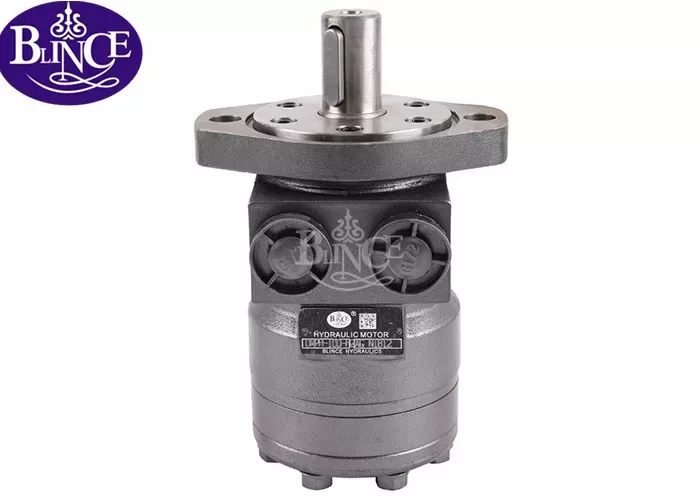
Figure: Blince hydraulic motor (BMR series) with integrated spring-applied brake on the rear flange. The built-in disc brake (green housing) clamps the shaft for fail-safe holding.
External Brake Systems for Hydraulic Motors
An external brake system uses a separate brake unit mounted on or coupled to the hydraulic motor’s output shaft. These can be hydraulic-powered disc brakes, pneumatic, or electric brakes. External brakes are not part of the motor itself but attach via an adaptor flange.
Greater Torque Capacity: Stand-alone brakes can be much larger than integrated ones. High-torque disc brakes (e.g. Danfoss BK series) can provide hundreds to thousands of Nm of holding torque. This allows stopping and holding overrunning loads that internal brakes alone cannot. Indeed, a hydraulic motor inherently leaks internally and cannot hold a heavy load by fluid lock alone. As one expert notes: “All hydraulic motors … can never be used to stop and hold an overrunning load… when it is necessary to stop and hold a hydraulic motor… an external brake is required.”. External brakes handle such heavy-duty cases.
Easier Servicing: Because the brake is outside the motor, maintenance is simpler. Brake pads/discs can be inspected or replaced without disassembling the motor housing. In retrofit cases, an external brake can be added to an existing motor for extra holding capacity.
Versatility: External brakes come in hydraulic, pneumatic or electric models. They can be spring-set and hydraulically (or pneumatically) released, combining fail-safe operation with high torque. Multiple brake discs can be stacked to increase torque.
Drawbacks of external brakes: They add space, weight, and complexity. A brake cylinder/valve is needed to release the brake. If the brake loses its supply (or spring is weak), it may fail to hold (so reliable control is still required). External systems also introduce more components that require maintenance (hoses, pump, seals).
Applications for external brakes include very heavy machinery and safety-critical situations. For example, large cranes, winches, drill rigs or hoists often use external disc brakes. In mining or forestry gear, an external spring-disc brake (or even dual brakes) ensures load holding on steep terrain. Because of their high torque and modular design, external brakes are common in Belt & Road projects (Russian mining, Chilean forestry, etc.) where equipment must handle extreme loads.
Blince Motor Series with Brakes (BMR, BMS, BMV)
Blince offers several motor series that can work with either integrated or external brake setups:
BMR Series (Gear/Orbit Motors): The BMR family includes models with built-in spring brakes (the BMR-BK01 series). These are gear (gerotor) motors similar to Danfoss OMR motors. As noted, BMR-BK01 units have an “integrated holding brake” and are compact yet high-torque. They serve moderate-load applications (plastic machinery, sweepers, small winches) where a motor with brake is needed.
BMS Series (Small Orbit Motors): The BMS series (sometimes labeled OMS or OMSY on Blince products) are orbital motors for lighter duty. They can be ordered with optional brakes – for example, Blince BMSY/BMSYB variants have integrated spring brakes for holding loads. These motors fit low-speed, high-torque uses like material-handling or agricultural drives, with a brake version providing auto-engage safety.
BMV Series (Large Orbit Motors): The BMV series includes very large gerotor motors (e.g. 630cc–1000cc) built for heavy-duty tasks. These motors do not come with internal brakes by default (due to size and typical use), but they can be paired with external disc brakes if needed. In contexts where BMV motors handle heavy loads (e.g. drilling rigs, large winches), engineers often mount a hydraulic or electric disc brake on the shaft or use an auxiliary brake system for safety.
Each Blince motor model references its brake feature in the product name and description. For example, the BMR-BK01 page explicitly says “hydraulic motor with brake… integrated holding brake”. When selecting a Blince motor, check if a brake option exists (e.g. models ending in ‘B’ or in the description) and verify its torque rating.
Comparison: Pros & Cons
| Feature | Internal (Integrated) Brake | External Brake System |
| Design | Built into motor housing (spring-applied disc/drum) | Separate unit mounted on output shaft or gearbox |
| Holding Torque | High for motor’s size (e.g. BMR series), but limited by motor size | Very high – can be scaled (Danfoss up to ~1500 Nm) |
| Safety | Fail-safe (engages on pressure loss) | Can be fail-safe if spring-set; requires own control |
| Maintenance | More complex (brake inside motor) | Easier access (separate pads/linings) |
| Space/Installation | Compact, fewer components | Requires additional space and mounting |
| Retrofitting | Must replace motor with braked version | Can add to any shaft/motor without brake |
| Use Cases | Conveyors, lifts, parking holds, small winches | Heavy hoists, cranes, overshot loads, mining equipment |
Pros & cons: An internal brake motor like a Blince BMR is easy to install and always holds the load if pressure drops. However, its brake torque is capped by the motor’s own size. An external brake can provide much higher torque and is serviceable separately, but adds complexity. For example, to stop a heavy drilling rig, an external disc brake (or secondary brake motor) is often preferred for the extra holding force.
Practical Use Cases
Blince BMR with Internal Brake: Used in factories, machinery and mobile equipment in Russia and Kazakhstan where compact design and safety are key. Examples: conveyor drives, sweepers, or mini-cranes where loads are moderate. The integrated brake ensures loads lock automatically.
Blince BMS with Brake: Ideal for agricultural or small construction machines (e.g. dumpers, planters) in Mexico or Kazakhstan. The spring brake in a BMS motor gives hold without extra valves.
External Brakes with BMV or Others: In Chilean mining or heavy construction (foundations, tunneling), equipment often needs very high holding torque. A large BMV motor coupled with an external hydraulic brake can secure heavy loads on steep grades. In many heavy-duty Belt & Road projects, adding a disc brake on the motor shaft (for example Danfoss BK or AB series) delivers the needed torque.
In general, if your application demands the motor to stop a spinning mass or hold a heavy load indefinitely, an external brake or additional holding valve is recommended. For lighter, safety-critical tasks, a Blince motor with integrated brake (a true “hydraulic brake motor”) provides simplicity and failsafe hold.
FAQ
Q: What type of brake is best for construction equipment in Russia?
A: Russian construction machines (cranes, loaders, etc.) often use spring-applied hydraulic brakes built into the motor for fail-safe holding. Blince’s BMR-series motors with internal brakes are popular for compact equipment. However, if the equipment bears very heavy loads or works on slopes, designers may add an external disc brake to boost torque. The choice depends on load size: for extreme loads, an external hydraulic brake provides extra holding power.
Q: What brake should I use on agricultural machinery in Kazakhstan?
A: For typical farm equipment (irrigation pumps, seed drills), an internal hydraulic brake on the motor (like Blince BMS/BMR with spring brake) is usually sufficient. It automatically locks when engine power is off. If the tractor or implement is very heavy or on steep terrain, one might also use a counterbalance valve or an auxiliary brake. In general, match the brake torque to the load: smaller machinery can use the motor’s internal brake, while larger implements may need an external brake or valve for safety.
Q: Which Blince motor series has the strongest brakes?
A: Blince does not specify “brake torque” on all motors, but generally larger series plus external brakes win. The BMR-series (small to mid-size) offers integrated brakes in a compact form. The BMV-series motors (630–1000 cc) handle heavier tasks but need an external brake for maximum torque. In short, for highest hold torque use an external brake with a large BMV or BMS motor. For moderate needs, a braked motor (BMR/BMS) is simpler.


