A tractor can steer normally across the yard and become stubborn after twenty minutes in the field. A forklift may turn easily with an empty mast, then require both hands when a pallet is raised. On an articulated loader, the steering wheel may kick when a tire climbs a rut. Another machine wanders slowly even though the steering wheel is being held still.
The steering control unit is often blamed first because the operator feels the fault through the wheel. Sometimes that judgment is right. The metering section may be worn, a spool and sleeve may stick, or an internal check or shock valve may leak. Yet the same complaints can begin at the hydraulic steering pump, a dirty priority valve, an undersized hose, a restricted return line, or a steering cylinder with internal leakage.
This is why a hydraulic steering system should be diagnosed as a circuit. Replacing the orbitrol by appearance alone may cure nothing, and a replacement with the same mounting pattern can still have the wrong displacement, center condition, reaction behavior, or port logic.
This guide follows the failure from the steering wheel to the tires. It explains where to measure pressure, how oil temperature changes the evidence, when priority flow matters, and what information is needed before choosing a hydraulic steering control unit.
Why Trust This Guide
Blince works across steering units, pumps, valves, cylinders, hoses, fittings, gauges, coolers, and complete hydraulic systems. That broader view matters because steering complaints rarely stay inside one component. A steering unit can meter correctly and still feel heavy if the pump is starved. A good pump can be blamed when a priority spool sticks. A new orbitrol can drift when a cylinder bypasses internally.
The practical method used here is consistent with Blince's hydraulic pressure gauge placement guide: test on both sides of the suspected loss and reproduce the condition that causes the complaint. A cold, unloaded check at idle is useful, but it cannot represent hot oil, low engine speed, tire scrub, or simultaneous implement demand.
This article is written for equipment owners, repair shops, maintenance teams, OEM buyers, and hydraulic distributors. It is not a substitute for the vehicle manufacturer's safety procedure or steering service manual. It is a field order of thinking that helps decide whether the next step is cleaning, adjustment, hose correction, cylinder repair, pump testing, or steering-unit replacement.
Start With the Steering Complaint, Not the Part Number
Before ordering a hydraulic steering valve, write down what the operator actually feels.
Does the steering become heavy only at idle? Is it heavy in both directions or one direction? Does the wheel turn without moving the tires? Does it kick when the tires hit an obstacle? Does the machine drift after the oil warms? Does steering improve when another hydraulic function stops? Did the complaint begin after a hose change, pump replacement, cylinder repair, or steering-unit installation?
Those details separate very different faults. Heavy steering at low engine speed points toward supply flow, inlet condition, or priority behavior. One-direction steering trouble suggests a work-port hose, cylinder chamber, mechanical stop, or a local valve fault. A wheel that turns while the tires remain still suggests leakage, air, a steering cylinder problem, or loss of metering drive.
For a service note, a plain sentence is more useful than “same orbitrol needed”:
Forklift steering is normal when cold. After 25 minutes, the wheel needs more effort at idle and becomes easier above 1,500 rpm. Pump inlet hose is soft, return oil is foamy, and steering pressure has not yet been checked at the steering-unit inlet.
That note gives the supplier a failure pattern. It also stops a catalog match from becoming a diagnosis.
What a Hydraulic Steering Control Unit Actually Does
A hydraulic steering control unit is both a valve and a hand-driven metering device. Turning the steering wheel shifts the internal spool-and-sleeve valve and rotates a metering section. Oil is directed to one side of the steering cylinder while oil from the opposite side returns through the unit.
When pump flow is available, the hydraulic supply does most of the work. If pump assistance is lost, many hydrostatic steering arrangements retain limited manual steering through the hand-metering action, but effort rises sharply and emergency behavior depends on the exact unit and circuit. Never assume every steering unit provides the same emergency performance.
Check tank level, foam, suction side, filter, and priority valve cleanliness
Wheels steer opposite to wheel direction after repair
L/R work hoses crossed
Verify port identification before operating again
Hard spot at the beginning of steering
LS signal delay, priority setting, cold oil, contaminated orifice
Check LS/PP line bleeding, signal pressure, and priority spool movement
Use the table to choose the next measurement. Do not use it to skip inspection.
Mechanical Checks Come Before Hydraulic Condemnation
Hydraulic steering can feel heavy because the front axle is mechanically heavy. Tire pressure, overloaded steer axle, dry kingpins, bent tie rods, damaged bearings, misaligned articulation joints, or a steering column that binds can all increase hand effort.
Raise or unload the steered axle only when the machine manufacturer permits it and the equipment is safely supported. Compare steering effort with the tires loaded and unloaded. If the steering is still notchy with hydraulic pressure removed according to the service procedure, the column or linkage deserves attention before the hydraulic steering control unit is replaced.
Impact damage matters. A loader that hit a curb may have a slightly bent rod or clevis. The steering cylinder can then side-load near one end of travel, making the fault look directional. Blince's hydraulic cylinder drift guide explains why cylinder sealing and mechanical load have to be separated.
Pump Supply and Priority Flow: Why Steering Loses the Argument
Many mobile machines use one pump for steering and auxiliary functions. A priority valve reserves controlled flow for steering and sends excess flow to other services. When the priority spool moves freely and the signal is correct, steering remains available even while implements work.
When the spool sticks, the spring is wrong, an LS orifice is blocked, or the pump cannot supply total demand, steering can lose that priority. The symptom often appears only when the loader raises, the mast tilts, or an attachment motor runs. At no load, the steering may look perfect.
A pump outlet gauge cannot prove that priority flow reaches the steering unit. Measure before and after the suspected priority section under the same operating condition. If the pump outlet stays healthy but steering-unit inlet pressure collapses when another function is used, the loss lies between those points or the circuit is overdemanded.
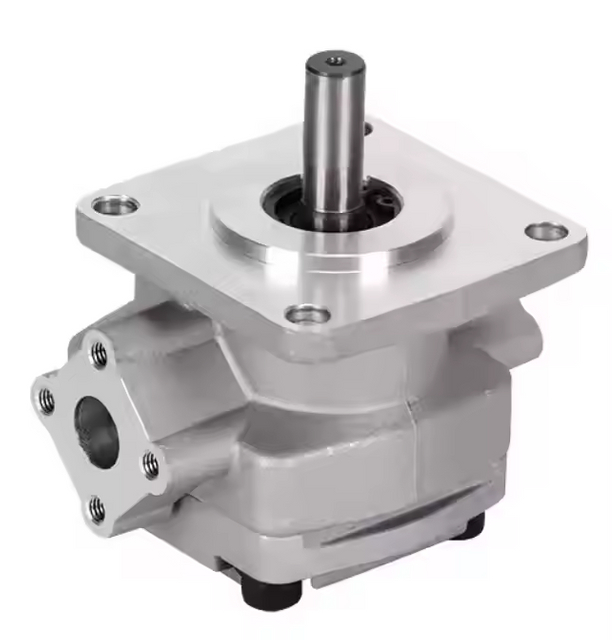
The Blince HGP series hydraulic gear pump is listed for applications including forklift hydraulic steering, but pump selection still requires displacement, speed, pressure, rotation, mounting, shaft, and inlet data. A steering complaint is not solved by choosing a pump only because its flange fits.
Heavy Steering at Idle: Flow Is Often the Missing Quantity
Pressure creates steering force, but flow determines how quickly the cylinder receives oil. A worn pump may still reach relief pressure during a static test while delivering too little useful flow at idle. The wheel feels heavy because the hand-metering section is doing more of the work.
Compare the symptom at idle, working rpm, and hot operating temperature. If steering improves sharply with engine speed, inspect pump delivery, suction condition, drive speed, and priority behavior. Do not increase relief pressure to compensate for missing flow. That adds heat and load without repairing the cause.
Flow testing should follow the vehicle manufacturer's method. A flow meter placed incorrectly can block steering or expose the technician to high-pressure oil. If direct flow measurement is not practical, pressure behavior, engine speed, wheel-turn time, oil temperature, and pump inlet evidence can still narrow the problem.
Pump Inlet Starvation Can Sound Like a Steering-Unit Fault
A steering pump cannot deliver oil that never reaches its inlet. Low reservoir level, a collapsed suction hose, a clogged screen, a closed valve, cold high-viscosity oil, or an air leak can reduce delivery before pressure is built.
The operator may report a growl through the steering wheel. The wheel may pulse, steering may lag, and the reservoir may foam. Because the noise is felt at the steering column, the orbitrol gets blamed even when the pump is aerating.
Inspect the suction hose for soft walls, kinks, loose clamps, hardened seals, and fittings with a smaller bore than the hose. Review oil grade and cold-start conditions. Blince's hydraulic contamination control guide covers the common air-entry paths that leave no external oil puddle.
Return Back Pressure Changes Steering Effort
Oil leaving the steering control unit needs a low-pressure return path. An undersized hose, restricted filter, crushed tube, tight fitting, or shared return manifold can raise outlet pressure. The pump may still show normal pressure, but the steering unit sees less useful differential pressure and more heat.
Measure return pressure near the steering unit and near the reservoir while steering against a realistic tire load. A large difference identifies the section of line causing the loss. If the return is shared with a motor, cooler, or valve bank, repeat the check while those functions operate.
Hose outside diameter does not reveal internal bore. A replacement hose may fit the thread and still be smaller inside. For routing, pressure, bend radius, and fitting checks, use the hydraulic tubing selection guide together with the actual steering flow requirement.
Steering Cylinder Leakage and Geometry
A worn steering cylinder can consume flow without leaving visible oil outside. Oil crosses the piston seal, so the wheel keeps turning while the rod moves slowly or the tires drift back under load.
Test cylinder leakage using the machine manufacturer's isolation procedure. Do not cap a loaded steering cylinder casually. Trapped pressure, tire force, articulation, and uneven ground can move the machine unexpectedly.
Cylinder geometry also changes the diagnosis. A single unequal-area cylinder does not behave like two balanced cylinders. Reaction-type steering arrangements may only be suitable where opposing cylinder volumes and steering geometry match the design. A replacement selected without cylinder information can introduce return-to-center behavior or wheel feedback that the old machine never had.
Air in the Steering Circuit: Bleeding Is Not the Whole Repair
Air makes steering springy, delayed, noisy, and inconsistent. The wheel may turn in small pulses, and the cylinder may move after the operator pauses. A quick bleed can improve the symptom, but repeated air means there is an entry point.
Check reservoir level, suction connections, return-line placement, pump shaft seal condition, and whether the oil is foaming. Inspect hoses through the full articulation range. A suction leak can draw air inward without leaking oil outward.
Bleeding procedures vary. Some systems require the axle to be unloaded; others specify slow lock-to-lock cycles, engine-off steps, or dedicated bleed screws. Follow the machine manual and never hold the steering hard against the stop longer than permitted, because relief flow turns pump power into heat.
Contamination: Small Orifices, Large Consequences
Priority valves, load-sensing passages, check valves, shock valves, and the spool-and-sleeve set depend on small clearances. Dirt can delay the signal, hold a valve off its seat, or make the steering feel different from one turn to the next.
If the fault began after a pump failure, hose replacement, tank repair, or long storage, treat the oil path as suspect. Clean-looking oil can still carry particles. Inspect the filter element, reservoir bottom, hose ends, and failed components before installing a new steering control unit.
Do not wash a steering unit externally and call the circuit clean. Debris can remain in the cylinder, hoses, manifold, or priority valve and return to the replacement. The repair is complete only when the entry point and debris path make sense.
Hot-Oil Drift and Internal Leakage
Hot oil is thinner than cold oil. Clearances that leak little in a morning test can pass more oil after the machine has worked. A worn pump may deliver less useful flow, a worn steering metering set may bypass internally, and a cylinder piston seal may leak faster.
Record the complaint with oil temperature. “Steering drifts” is incomplete. “Steering holds for ten minutes at 28°C and begins to wander after the return oil reaches 62°C” gives the technician a repeatable condition.
If oil temperature continues to rise, find the heat source before fitting a larger cooler. Relief flow, priority-valve pressure drop, return restriction, and internal leakage all convert useful power into heat. The hydraulic oil cooler sizing guide explains why cooler size cannot correct a circuit that is wasting power continuously.
Steering Wheel Kickback: Feedback or Fault?
Not every movement at the wheel has the same cause. A reaction steering unit can allow forces from the steered wheels to influence the steering wheel and help the wheels return when geometry provides a centering force. A non-reaction unit is intended to isolate the wheel more strongly in neutral.
Heavy kickback can also indicate system trouble: wrong unit type, incorrect internal timing after repair, missing or leaking checks, LS signal problems, air, or mechanical impact at the axle. If kickback started immediately after steering-unit replacement, verify the complete model code and circuit type before adjusting anything else.
Danfoss technical literature notes that check arrangements in pressure and LS lines can be used to avoid steering-wheel kickback in dynamic load-sensing systems. That is a circuit-design detail, not permission to add an arbitrary check valve. A misplaced check can block manual steering, trap pressure, or prevent the correct LS signal.
Open Center, Closed Center, and Load Sensing Cannot Be Swapped by Guesswork
An open-center steering unit passes pump flow in neutral. A closed-center unit blocks or controls neutral flow for a different pump arrangement. A load-sensing unit sends a demand signal to a priority valve or pump control.
Install the wrong center type and the machine may heat at neutral, starve steering, keep the pump loaded, or fail to develop the expected priority signal. The outside casting can look nearly identical, so photographs alone are not enough.
Record every port marking, including P, T, L, R, LS, and any power-beyond or auxiliary port. Photograph the old hose routing before removal. Mark hoses physically; memory is unreliable after several lines have been disconnected.
Port Connections: A Thread Match Is Not a Circuit Match
P is normally the pressure supply and T the tank return; L and R feed the steering cylinder. LS identifies a load-sensing signal where used. Yet manufacturers may arrange ports differently, and adapter blocks can hide the original labeling.
Crossing L and R can make the tires steer opposite to the wheel. Connecting T to a pressurized gallery can raise case pressure and damage seals. Blocking an LS or auxiliary port can create a hard starting point or remove priority response.
Thread form and sealing method also matter. A metric thread, BSP port, SAE O-ring boss, and tapered pipe thread may look close enough to start but are not interchangeable. The hydraulic hose crimp fitting guide is useful when adapters or new hose assemblies are part of the replacement.
A Practical Pressure-Test Sequence
Plan the test before connecting gauges. Confirm rated pressure, safe access, hose restraint, steering stops, and machine support. Use suitable test hoses and gauges, and keep people clear of articulation and tire movement.
Record oil level, oil condition, oil temperature, engine speed, tire pressure, and the exact symptom.
Measure pump outlet pressure and, where permitted, available flow at the speed that produces the complaint.
Measure pressure at the steering-unit inlet before and during steering.
If a priority valve is used, compare supply, controlled-flow, excess-flow, and LS behavior according to the circuit.
Measure L and R work-port pressure while turning each direction under comparable load.
Measure return pressure near the steering unit and near the tank.
Repeat the relevant readings after the oil reaches the temperature at which the fault appears.
Isolate steering-cylinder leakage only with the approved procedure.
Compare the findings with the machine schematic before ordering parts.
The numbers should be recorded as a set. A 150-bar inlet reading without engine speed, oil temperature, steering direction, and return pressure is only a fragment.
How to Interpret the Measurements
If pump outlet pressure is low and steering-unit inlet pressure is also low, inspect pump supply, relief setting, speed, and inlet condition. If pump outlet pressure remains available but steering inlet falls when another function operates, inspect priority flow and upstream pressure loss.
If steering-unit inlet pressure is high but one work port remains low, investigate internal steering-unit leakage, port valves, hose restriction, or the connection to that cylinder chamber. If both work ports build pressure but the cylinder barely moves, the cylinder or mechanical linkage deserves attention.
If return pressure is high, usable pressure differential is being lost. Locate the restriction by moving the measurement toward the reservoir. One convenient main gauge cannot do this work.
Choosing Steering-Unit Displacement
Steering-unit displacement is commonly expressed as volume per steering-wheel revolution. It influences how many wheel turns are required to move the steering cylinder through its stroke and how much oil the unit meters per hand-wheel turn.
A larger displacement does not simply mean “stronger steering.” It generally moves more oil per wheel revolution and can reduce the number of steering-wheel turns, but it also changes hand effort, required pump flow, response, and emergency steering behavior. A smaller displacement can require more wheel turns and may feel different even when the machine eventually reaches the same steering angle.
The correct choice depends on steering-cylinder volume, desired lock-to-lock turns, pump flow, vehicle speed, axle geometry, and safety requirements. Keep the original displacement unless an engineering review supports a change.
Replacement Selection Checklist
Information to collect
Why it matters
Full model code and nameplate photos
Identifies family, displacement, center, and options
Displacement per revolution
Determines wheel turns and metered volume
Open center, closed center, or load sensing
Must match pump and priority architecture
Reaction or non-reaction behavior
Changes wheel feedback and return behavior
Port markings, thread, seal, and position
Prevents wrong routing and leakage
Shaft type and column connection
Ensures mechanical compatibility
Mounting pilot and bolt pattern
Keeps the unit square and secure
Pump flow, pressure, speed, and rotation
Confirms available steering supply
Steering-cylinder bore, rod, stroke, and arrangement
Establishes required oil volume and force
Priority valve and LS details
Explains multi-function behavior
Built-in relief, shock, suction, and check-valve options
Preserves protection and steering response
Machine type, axle load, tire size, and duty
Connects catalog data to real steering demand
Hot and cold symptom notes
Separates viscosity and leakage effects
If several items are unknown, selection can begin, but it should be described as preliminary. A unit that fits the column can still be wrong for the hydraulic steering system.
Blince Steering Control Unit Options
Blince's steering range includes the 100 series hydraulic steering control unit, offered for applications including tractors and heavy machinery. The product page describes a cast-iron construction and steering control unit with valve-block configuration. Final selection still needs the full code and circuit data.
The Blince BZZ series steering control unit is presented for heavy-duty applications, with the product listing referencing BZZ1-E 500/630/800 cc orbitrol forklift variants. Those listed displacements are not interchangeable by default; the machine's cylinder volume, desired wheel turns, pump supply, and original center type must be checked.
When an old unit has no readable tag, send clear photographs of all sides, the shaft, mounting face, ports, valve block, and hose routing. Add measured mounting dimensions rather than estimating from the image.
Equipment-Specific Checks
Tractor Hydraulic Steering System
Tractors work across changing engine speed, tire load, mud, dust, and long idle periods. Heavy steering at idle may be pump-flow or suction related. Steering that becomes erratic after storage may involve air, water, a dirty priority spool, or a hardened suction hose.
Front loaders add axle load and raise the steering force required while stationary. Compare steering with the bucket empty and loaded, but do so only within the manufacturer's safe test conditions. A unit that feels adequate on an unloaded tractor may be incorrectly sized or poorly supplied under loader duty.
Forklift Hydraulic Steering System
Forklifts often share hydraulic power between steering, mast lift, and tilt. Test steering while the mast functions are used. If hand effort rises only during lift or tilt, priority flow and pump delivery deserve attention before the orbitrol is condemned.
Forklift tire type, steer-axle condition, mast load, and low engine speed all affect the complaint. A forklift steering gear pump must still be selected by actual displacement, rotation, shaft, flange, pressure, and speed data.
Loaders and Articulated Machines
Articulated machines place hoses through repeated bending and expose the center joint to dirt and impact. Inspect hose routing at full left and right articulation. A hose can look open in the straight position and kink near full lock.
Cylinder pin wear and articulation-joint clearance can produce wandering or a delayed response that resembles internal hydraulic leakage. Mark the joint and observe mechanical movement before replacing hydraulic parts.
Harvesters and Agricultural Equipment
Harvesters may sit for months, then work long days in heat and crop dust. Check tank breathers, filter history, suction hoses, oil condition, and rod contamination before the season. One stuck signal orifice can create an intermittent steering complaint that disappears in the workshop.
Common Mistakes
Mistake 1: Replacing the Orbitrol Because the Wheel Feels Heavy
The wheel is where the operator feels the problem, not necessarily where the problem begins. Check mechanical linkage, pump supply, priority flow, inlet condition, and return pressure first.
Mistake 2: Choosing by Shaft and Bolt Pattern
Mechanical fit does not prove hydraulic compatibility. Displacement, center type, reaction behavior, ports, LS arrangement, and valve options must match.
Mistake 3: Increasing Relief Pressure to Fix Slow Steering
Relief pressure does not create missing pump flow. If the pump is worn or starved, a higher setting adds stress and heat.
Mistake 4: Testing Only With Cold Oil
Cold oil can hide internal leakage and exaggerate inlet restriction. Record both cold-start and normal-temperature behavior.
Mistake 5: Ignoring the Steering Cylinder
A bypassing piston seal can consume metered oil, and worn linkage can create apparent drift. Isolate the actuator before blaming the steering valve.
Mistake 6: Cleaning the Steering Unit but Leaving Dirty Oil
Contamination in the tank, priority valve, hoses, or cylinder can damage the cleaned or replacement unit again.
Mistake 7: Crossing Work Ports During Installation
Mark hoses before removal. A reversed L/R connection can make the machine steer opposite to the wheel.
Mistake 8: Treating All Kickback as a Defective Unit
Reaction design, steering geometry, check-valve arrangement, LS behavior, and axle impact all affect wheel feedback. Compare the replacement code and circuit first.
Mistake 9: Holding the Wheel Against the Stop During Diagnosis
Extended relief operation creates heat and can overload the pump. Use only the test duration allowed by the machine manufacturer.
A Quote Request That Helps the Supplier
Instead of writing “quote same steering valve,” send a short technical note:
The machine is a 4-ton forklift with a shared pump for steering and mast functions. Steering is normal cold, becomes heavy at idle after 30 minutes, and improves above 1,600 rpm. It also becomes heavy while the mast lifts. The old unit code is partly readable; displacement appears to be 160 cm³/rev. Ports are marked P, T, L, and R. Pump outlet is 145 bar during lift, steering-unit inlet is 58 bar during the complaint, return pressure has not yet been measured. Photos of the unit, shaft, mounting face, hose routing, and pump tag are attached.
That message points toward priority flow and pump delivery while giving enough information to begin replacement identification.
For an unreadable unit, include a ruler in mounting and shaft photographs. Measure pilot diameter, bolt spacing, shaft spline or key, port threads, and overall height. State whether the steering wheel returns, kicks, or remains isolated when the tires are forced by the ground.
Frequently Asked Questions
What causes hard hydraulic steering at low engine speed?
Common causes include low pump flow, pump inlet starvation, a sticking priority valve, incorrect LS signal, cold high-viscosity oil, or excessive mechanical axle load. Compare the symptom at idle and working speed, then measure steering-unit inlet conditions.
Can a hydraulic steering pump make pressure but still have low flow?
Yes. A worn pump may reach pressure during a short stall while delivering insufficient useful flow at idle or after warm-up. Pressure and flow answer different questions.
Why does steering become worse when the oil gets hot?
Hot oil leaks more easily through worn pump, steering-unit, and cylinder clearances. The pump may deliver less useful flow and the metering unit may bypass more internally. Repeat tests at the temperature that creates the complaint.
What causes steering wheel kickback?
Possible causes include reaction-type behavior, wrong replacement type, LS or pressure-line check faults, incorrect internal timing, air, or impact forces from the axle. Heavy new kickback after replacement requires a model and circuit review.
Can high return pressure cause heavy steering?
Yes. High return pressure reduces useful pressure differential and creates heat. Measure return pressure near the steering unit and near the tank to locate the restriction.
Why does steering become heavy when another hydraulic function operates?
The pump may lack total flow, or the priority valve may not reserve enough flow for steering. Test the steering inlet and priority section while the second function operates.
Can a steering cylinder make the steering wheel keep turning?
Yes. Internal piston-seal leakage can let metered oil cross the cylinder, so wheel movement produces less tire movement. A worn steering unit can produce a similar symptom, so isolate the cylinder safely.
Can I replace an open-center steering unit with a closed-center unit?
Not without a circuit redesign and manufacturer approval. The neutral-flow behavior is different and a mismatch can cause heat, pump loading, or loss of steering supply.
Is a larger steering-unit displacement better?
Not automatically. It changes metered volume per wheel turn, lock-to-lock turns, hand effort, flow demand, and emergency steering behavior. Match it to cylinder volume and the original design.
What information is needed to identify an orbitrol steering unit?
Provide the complete code, displacement, center type, reaction type, port markings and threads, shaft, mounting pattern, valve-block options, pump data, cylinder data, machine model, and photographs.
Should steering be tested only at full lock?
No. Full-lock tests mainly show relief behavior and should be brief. Useful diagnosis also measures normal turning, idle behavior, work-port pressure, return pressure, and interaction with other functions.
What should be cleaned after a steering pump failure?
Inspect and clean the reservoir, filters, suction screen, priority valve, hoses, steering unit, cylinder paths, and return line as appropriate. Metal can remain in the circuit and damage a replacement.
Final Takeaway
Hydraulic steering diagnosis should begin with the machine's behavior, not the casting number. Hard steering, wheel kickback, hot-oil drift, and slow response can come from the steering control unit, but they can also begin with pump flow, priority logic, inlet starvation, return back pressure, cylinder leakage, air, contamination, or mechanical axle load.
Follow the pressure and flow path. Reproduce the complaint at the correct engine speed, oil temperature, tire load, and simultaneous-function demand. Then match the replacement by displacement, center type, reaction behavior, ports, mounting, shaft, and valve options.
For hydraulic steering control unit selection or repeat-failure diagnosis, send Blince the machine model, old-unit code, displacement, port and shaft photographs, pump flow and pressure, steering-cylinder data, oil temperature, priority-valve arrangement, and the exact symptom. Blince can compare the BZZ steering control unit, 100 series steering control unit, pump, hoses, and related circuit components before you commit to a replacement.
This article is a general engineering guide. Final component selection should be based on machine drawings, measured hydraulic data, working conditions, safety requirements, and confirmation from a qualified hydraulic engineer or supplier.
Blince Hydraulic Team
Blince Hydraulic is an industry-leading company dedicated to precision-engineered fluid power manufacturing and custom hydraulic solutions. Backed by decades of deep field expertise in industrial machinery and thousands of successful global deployments, our engineering team focuses entirely on high-performance hydraulic component manufacturing, including specialized orbital motors, high-pressure travel drives motor, and robust directional control valves. Our production infrastructure utilizes state-of-the-art multi-axis CNC machining systems and is fully ISO 9001 certified to guarantee repeatable volumetric accuracy across every single manufacturing run.
We deliver fast, highly dependable, and cost-efficient hydraulic solutions to heavy industry distributors, machinery OEMs, and maintenance crews across more than 150 countries. Whether your active project calls for a small-volume batch of customized shaft profiles or a large-scale production run of severe-duty cast iron gear pump, we configure our flexible production schedules to meet your target lead times with total pricing predictability. Partnering with Blince means securing maximum system efficiency, elite material quality, and uncompromised fluid power professionalism.
To learn more about our complete product lineup, visit our official website: www.blince.com.